by Gifford and Eileen Eardley
One of the important annual events which was celebrated at Kogarah in the first and second decades of the 1900s was the observance of St George’s Day, a festival which falls on April 23rd. The late Reverend Harry Reginald Arthur Wilson, a fervent English patriot, who was the priest at St Paul’s Church of England, Kogarah, in the Parish of St George, between 1905 and 1921, was responsible for an annual rally of his parishioners and the local school children, which was held on the Saturday afternoon which happened to be nearest to the accepted commemoration date.
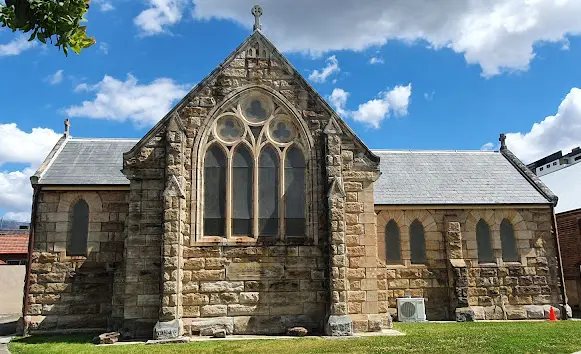
The enthusiasm of this particular reverend gentleman for his beloved England, and all its glorious associations, knew no bounds and, after coming to the Anglican Parish of St George, Kogarah, it was not long before he set about devising ways and means to publicly honour the patron saint of England, his church parish, and also of our land district sited between Cooks River and Georges River. To this end a procession of children was organised to pass through the streets of Kogarah on the appointed Saturday afternoon, led by a local brass band, to a sports meeting held in St Paul’s Church Ground between Rocky Point Road (now Princes Highway) and Gladstone Street.
Harry Green, a soldier of the Boer War, and a weekend resident of Arncliffe, where he spent most Saturdays and Sundays living in an enclosed cave near the crest of the sandstone hillside at the north-western corner of Duff and Hill Streets, played the part of St George. Green was clad in tin-plate armour and, mounted on a white horse loaned by a local tradesman, carried the flag of St George, a red cross on a white ground, at the head of the procession. Then, in order of age, trooped the little girls, followed by the elder girls, in cross rows of four, each class being in charge of its teacher. The girls were mostly clad in white with sashes of red ribbon, and marched in quite good order, accompanied by the cheers and ovations of their excited parents. Then came the drum and fife band belonging to Kogarah Superior Public School, the big drum being supported in front by a callow youth chosen by dint of his very sturdiness.
The boys then followed in motley array, some with boots and some without, but each sported a red and white rosette and marched as they saw fit. Some ambled along, others pushed their neighbours, others tripped over projecting stones in the surface of the unsealed roadway, and all generally behaved as expected, much to the annoyance of their teachers and the amusement of the bystanders. Pea-shooters were surreptitiously brought into action, the peas being unknowingly supplied by various unfortunate produce merchants, such as Napper of Rockdale and Soames of Kogarah. Direct hits behind the ear to some lad in front created a popular diversion for those following behind and often led to scuffles which upset the more or less orderly conduct of the march.
If our memories are correct the early processions were marshalled on Rocky Point Road at Skidmore’s Bridge, in the vicinity of a shopping plaza. When all was ready the vanguard moved off with St George in the lead, riding a horse which did not greatly appreciate the music of brass bands, and tended to be skittish in consequence. The representative of St George had difficulty at times in controlling his nag with one hand only, due to the fact that the other hand was more fully occupied in holding the flapping flag aloft.
The procession turned into Regent Street which was traversed as far as the intersection of Gladstone Street, then this latter thoroughfare was followed to the entrance gates of the St Paul’s Cemetery. Here the procession filed through the narrow width picket gates, as convenient in ones and twos, before sauntering through the cemetery path until the separating gates of St Paul’s Churchyard were reached. Here each child was presented with a small paper bag of boiled lollies issued in honour of the occasion, stringent precautions being taken to prevent any attempt at “doubling-up”.
St Paul’s Churchyard was commodious and quite suitable for juvenile racing, three-legged races, egg and spoon races, and tug-of-war for the boys, and also grown-ups of each sex. Maypoles were set up for the girls and their sedate dancing around these pagan symbols was most pleasing to watch. The sporting proclivities of each sex were centrally divided by the grand old stone church. Races were run according to age groupings and prizes awarded to the winning contestants, most prizes being wheedled out of tradespeople sympathetic to the cause.
Races and games, to the accompaniment of the brass band repertoire of patriotic airs, continued until dusk when the various contestants dispersed. However, the activities of the St George’s Day Committee were then concentrated on the St George’s Day Tea, which was held in the adjacent Parish Hall. Long trestle tables were set out and the Sunday School forms arranged to seat the ticket-holders, who were charged the sum of one shilling each for admission. The board tables were covered with sheets of white paper, and long rolls of narrow crepe paper, of a most gorgeous red, was laid across and down the central length of the table to portray the red cross flag of St George. Red and white dahlias, displayed in the “best vases of the women members of the committee, graced each table, together with a more than plentiful supply of sandwiches, cakes, and soft drinks. Speeches were also in plentiful supply and representatives of the Royal Society of St George sat at the official table, together with the clergy, members of parliament, church wardens, and local aldermen. This festive board commenced operations at about 7pm and, when the last speech and the final toast had come to their appointed ends, the patrons adjourned to the Parish Church to hear Mr. Haywood, the organist, give a short recital. The arrangement kept them away whilst the committee hastened to clear the Sunday School Hall of its cluttering tables, trestles, viands, and spillages, preparatory to spreading handfuls of sawdust on the floor for the inevitable dance program.
Dancing was interspersed with vocal items whereby bassos from the choir sang “Land of Hope and Glory”, and Clement Kelly, the kindly editor of The St George Call, always obliged with “The Gallant’s of England”. Another regular item, especially fostered by the younger generation, was the old song “Thora”, sung with deep feeling and great expression by Sydney Kelly, much to the edification of his mates.
It is of interest to recall, some of the names of the committee members of those now far-off days. Amongst the male members would be Alan Butcher, Tom Eardley, Fulford, C. J. Kelly, Livingstone, Perry, Les Walker, Charlie Smith, and Wolfe, to quote a few, whilst the stronger sex was ably represented by Miss Butcher, the Misses Moister, and Miss Varcoe, and Mesdames Carlaw, Carmichael, Tom Eardley, C. J. Kelly, P. N. Kelly, Livingstone, Mitchell, Moore, Reid, Skidmore, N. Wakefield, and Warner, to name just a few more than willing workers associated with the great annual event.
The Reverend Wilson resigned from St Paul’s Church at Kogarah and returned to his well-beloved England. With his departure the procession through the streets of Kogarah and the games afternoon were abandoned, but the St George’s Day Tea Meeting continued for several more years during the incumbency of the Reverend Stanley G. Best.
In conclusion it should be mentioned that in its latter years the children’s procession was marshalled in Railway Parade, in the vicinity of the Bellevue Street intersection and the now long-demolished steam tram car shed. The route taken was via Regent Street to Gladstone Street and from thence to the cemetery gates of St Paul’s churchyard as before described.
This article was first published in the April 1968 edition of our magazine.
Browse the magazine archive.