

by Gifford Eardley
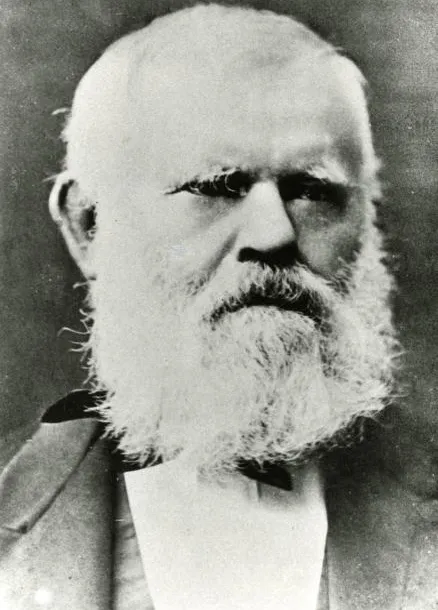
Sydneytown has always suffered chronic water shortages and many different schemes have been brought forward over the years to alleviate this unfortunate position. In the 1860s, when fresh water supplies were indeed running low, a proposition was made by Thomas Holt to construct a dam across Georges River between Rocky Point and Taren Point. There was some merit in the scheme which led to a thorough investigation of the proposal by departmental officers under the direction of a Royal Commission appointed by the New South Wales Governor.
We cannot do better than quote Holt’s letter, dated 30 March 1869, which reads:- “A survey was made in the 1860s of the country between Salt Pan and Wolli Creek (branches of the Georges River and the Cooks River) as part of a scheme by which the City of Sydney and its suburbs might be supplied with an abundance of pure water. My attention has been drawn to another plan which could be combined with that of a water supply. There is almost a continuous line of creeks or swamps between Georges and Cooks Rivers, and there is a creek, known as Sheas, from Cooks River to not far from the railway, near Redfern, which could easily be converted into a navigable canal.
If Georges River were dammed at Sans Souci, and Cooks River at or near the Waterworks, a few floods would wash out all the salt water therefrom, and a canal cut through the swamps and creeks, would convey this vast body of water close to the suburbs of Sydney without the expense of a shilling for iron pipes. A dam near the waterworks at Botany would tend to secure the present limited supply in the Botany Swamps, and the waters of the united rivers (Georges and Cooks), when sweet, could be pumped by the same engines that now supply Sydney.
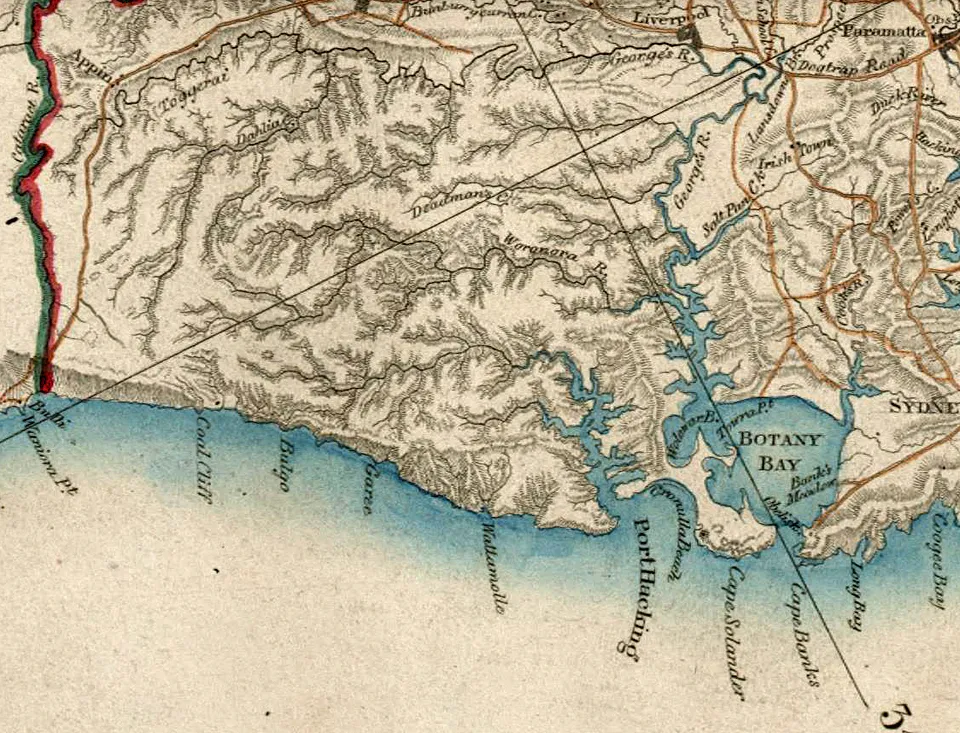
If the question were merely the water supply of Sydney and its suburbs, it would be immaterial where Georges and Cooks rivers were dammed. A dam at Tom Ugly’s Point, or at Kangaroo Point, would be somewhat shorter than a dam at Sans Souci, but the river is much shallower at Sans Souci, and therefore I do not think there would be much difference in cost. The cost of damming Cooks River at the waterworks would be greater than constructing a dam at Unwin’s Bridge (near Tempe), besides a dam at the waterworks would be worth every shilling it cost, as a road to Seven Mile Beach.
There is something grand in the idea of having a canal of fresh water close to Sydney, and something equally grand, although not so useful, in having a navigable canal to some of the most beautiful scenery in the world. I saw no beach in Europe so beautiful as Seven Mile Beach, although only about half a dozen miles from Sydney, probably not more than ten dozen of the citizens have ever been on it. Indeed, the approaches to it, until very recently, were almost inaccessible, and at present they are exceedingly difficult. Georges River would make as beautiful a lake as any to be found in Europe, if we except the high mountains with which some are surrounded.
If the citizens could start from the centre of the city for our “new river” and proceed thence by steamer either to the waterworks or to the Seven Mile Beach, or to Sans Souci, or to the numerous bays or branches of Georges River (or rather lake) to Liverpool – the people of almost every other city might then envy Sydney as the “Queen of Cities.”
For considerably less than £200,000, I doubt not, Georges and Cook could be dammed, and the natural creeks and swamps between these rivers made into a navigable canal, and the fresh water brought, without the expense of a single main, to near Redfern.”
Thomas Holt sent a further letter relative to the above scheme, which was written at his residence, “The Warren”, (located on the hillside immediately west of Tempe Railway Station) on 4 May 1869. I again take the liberty of quoting his letter in full.
“I have had some conversation with a person who has had considerable experience in damming, embanking etc. He told me that there could not be better materials for a dam than sand and gravel, provided there was abundance of them, so that the dam could be made sufficiently wide, with a slope similar to a sea beach. His idea of making a dam across Georges River was, first to make it of stone, just as it comes out of the quarry, in order to lay thereon a railroad for the sand and gravel, which could be shot out of the trucks at the sides. He said he had constructed a dam in Tasmania of sand and gravel, and that there was a flood immediately after he had finished it, when the water rose 25 feet above the dam, without injuring it in the slightest degree.
I told him that there was a high mountain of sand three miles long, about four miles from Cummins Point (now Taren Point), where the trucks could be filled with very little labour from the top of the mountain, by means of a chute, and that the land from the mountain to Cummins Point was on a slight decline, also that there was an abundance of stone close at hand. He said – You have all the materials required for the dam, and with such natural advantages, it could be constructed at comparatively little expense.
Between Cummins Point and Rocky Point (Sans Souci) the river is very shallow and there is little if any mud. One third of the river is dry at low tides. But as you had told me that there is a great depth of mud at Tom Ugly’s Point, I thought I would ask my practical informant how he would get rid of it? “Get rid of it,” he answered, “why the weight of the stones and sand would effectually squeeze it out.” Do not your very footsteps, on muddy roads, demonstrate to you that this is practicable? I asked him if he thought there was any fear of the seawater oozing through the dam and making the water above it brackish. He answered “Never”. Be sure, he said, to make your dam wide enough – it cannot be too wide – with the natural slope, and it will become as durable and as impervious as the sea beach.
What more could nature do than she has done to assist the citizens of Sydney in providing for themselves an inexhaustible supply of pure water. There is a watershed which could not be surpassed, there are numerous reservoirs (Georges, Cooks and Woronora Rivers, besides some creeks as large as rivers), and there are swamps almost the entire distance from Georges River to the Sydney suburbs.
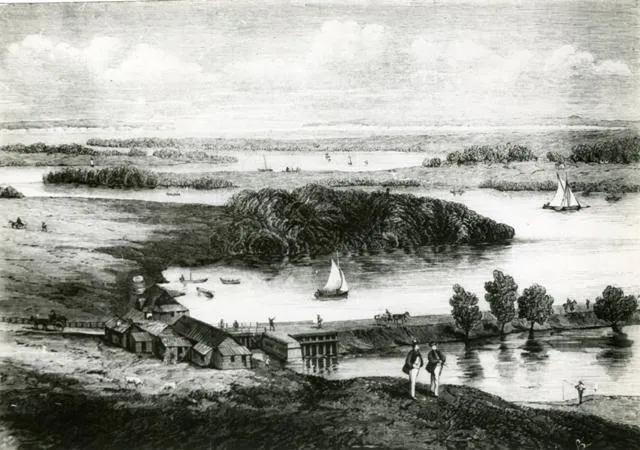
A ship canal through the swamps, from Georges River to the railway near Redfern, would not cost a large amount, but a watercourse or canal capable of supplying hundreds of thousands of persons would be very inexpensive. For instance, instead of the canal being made to the Georges River, it need not go further than the head of Kogarah Bay (or Townsend’s Bay), a branch of Georges River, and within 200 or 300 yards of Pat Moore’s Swamp. There is a low place about a mile on this side of Sans Souci which would require very little cutting. A canal through the swamps, say 12 feet wide at the top and 9 feet wide at the bottom, would not cost (I think) more than £2 a rod, or £640 a mile. At a rough estimate I think, Sydney might be supplied with as much water as it is ever likely to require, for less than £25,000 (exclusive of compensation for land) say –
For cutting a canal 9 miles long at £640 a mile: £5,760
For Damming Georges River – Say £15,000
For Damming Cooks River – Say £1,000
Total £21,760
But if it were to cost £40,000, or £60,000, or even £100,000, it would be the cheapest and most valuable work ever executed in New South Wales. I am told that the rough stone in the centre of the dam would soon settle down and become as solid as a rock, and that the large body of sand on both sides would soon fill up all the interstices of the stone.
Cummins Point is also a most excellent site for a weir, equal to Tom Ugly’s or Kangaroo Point, so that not one drop of water ever need run over the dam.
If, as I firmly believe, neither piles, nor cut stones, nor coffer-dams, are required in making the dams, but only an abundance of materials which has been so liberally furnished. There are no engineering difficulties, it is more labourers’ work. We have merely to use the stone and sand, and separate the salt water from the fresh, deepen and widen the watercourse nature has prepared, and the numerous complaints made by the citizens, of a scarcity of water, would cease for ever.”
Edward Moriarty, then Engineer for Public Works, however, did not appear to have had much faith in the Georges River dam scheme as brought forward by Holt. In his report to the Government he mentions that “the feasibility of the project depends wholly on the successful construction of the dam; and there can be no doubt that, owing to the great depth of water, the nature of the bottom, which is composed of semi-fluid mud and sand, the permeability of the sand, and the fissured open character of the rock forming the sides of the channel, to make a dam watertight in such a situation would be a work of extreme difficulty. In reference to the dam, the first question which presents itself for consideration is, as to the character of the work of which it should be composed – whether it should be constructed of masonry carried down to and founded on bedrock which underlies the sand at depths varying from 50 to 60 feet below highwater mark; or of puddle enclosed by sheet piling, and faced on either side by a stone embankment; or of sand wholly as suggested. He thought that the sand barrier would leak, and also that there would be little hope of ever removing the salt from the enclosed waters and mud of the numerous bays sited along the course upstream. He quoted the case of the Dutch-built polders (low-lying tracts of land, enclosed by embankments (dikes)) erected for miles along the North Sea coastline, in order to reclaim land for agricultural and other purposes, and pointed out that the Dutch only worked in shallow water.”
Unless otherwise noted, images are courtesy of the Bayside Library Service Local History Collection.
This article was first published in the August 1966 edition of our magazine.
Browse the magazine archive.