
by Frederick Day
With the advent of a new post office in Bexley, interest is stimulated in early methods of communication and the development of postal facilities in the old Municipality of Bexley.
Records reveal that postal services are of great antiquity, dating back to the ancient Persians, who employed relays of men and horses to carry messages. The Romans used a similar method and in the 13th century, messengers were employed in England to carry the King’s correspondence.
The office of Postmaster of England existed during the reign of Henry VIII. Public agitation led to the establishment of a General Post Office in London in the 17th century.
During the 1800’s the postal system was changed and modernised. In 1840, a uniform penny rate for letters up to ½ oz. in weight was introduced and soon afterwards, postage stamps replaced the system of payment in advance. Eventually telegraph and telephone services became part of the British postal services and a Post Office Savings Bank was instituted.
In 1874, an International Postal Union was established at Berne, which guaranteed rights of mail transit through all countries belonging to the Union.
Australia’s postal system began in NSW with the establishment in 1809 of the first post office in Sydney.
Postal facilities in the early days of Bexley were provided by a sub-post office in a shop in Forest Rd. approximately opposite the present post office. Eliza Pearse was storekeeper and post-mistress from 1888 until 1900, when Jessie Clune took over. She was succeeded by Alice McBride, who held the position from 1912 to 1928 in conjunction with her newsagency.

Early records referred to postmen as “letter carriers”. Household deliveries were usually made through a small opening in the front door, or pushed under the door, until the Postal Department insisted on letter boxes on front fences or gates. Mail for Bexley Council was left in a box on the back door of the Council Chambers.
In 1909, the postmistress at Carlton was permitted to close at 1 pm on Wednesdays for a weekly half-holiday and two years later she was informed that Council would not object if the office was closed at 1 pm on Saturdays instead of Wednesdays. McBride then asked if the Bexley office could be closed at 1 pm on Saturdays, Council agreed, and post office hours became 9 am to 6 pm Monday to Friday and 9 am to 1 pm on Saturday.
Receptacles for the collection of letters had been placed in some streets, and, to make them more easily identified, uniformity of design was advocated in 1924. These boxes were cleared at 9 am and 3 pm. The Bexley office had an extra clearance at midday.
Complaints were being made to the Postal Department in 1905 about the late delivery of mails and the uncertainty of postal addresses on the Bexley side of the railway line. This culminated in a request either for an extra letter carrier, or that mail be delivered from the Bexley office instead of Rockdale. There were repeated requests for an official Post Office in Bexley, but it was not until 1928 that the building was erected. Council invited the Postmaster General to open the new office, but the Department arranged for him to be represented by Thomas John Ley.
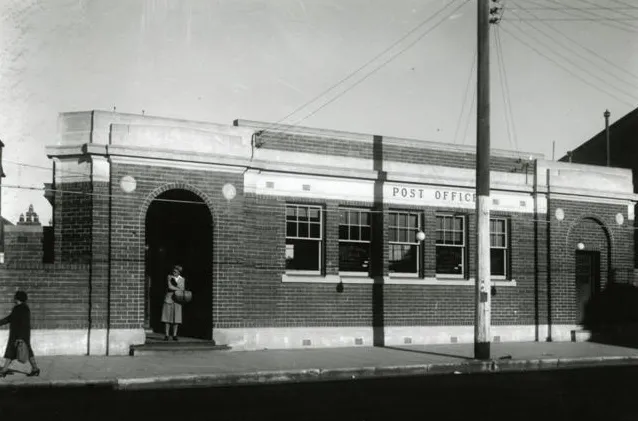
In 1938, when the Department was still using public transport for the movement of mails, the Arncliffe-Bexley bus carried bags of mail, making it necessary for the bus to stop outside the post office at certain times during the day. This custom upset those people who wished to use the space for parking their vehicles and it was the cause of complaints to the Council.
A proposal was made for a right-of-way from Forest Rd to Albyn St via the PMG property, but this was not acceded to. In 1935, the Department was asked to put a clock outside the post office, but the request was refused, the reason given being that clocks had not been provided on post offices for many years.
The system of sending outwards telegrams by telephone from Bexley Post Office was changed to Morse in 1930.
As early as 1918, Councils were trying to induce the Government to erect locality signs on post offices. This was done, but for the duration of World War II, all names were removed.
It is recorded that in 1943, a local resident addressed a letter to herself and posted it in a letter box in Bexley. Three weeks later, the letter had not been delivered.
In 1936, the Bexley Citizens League asked for a sub-post office at 691 Forest Rd, near Willison Rd. This site was chosen because it was one mile from Bexley Post Office, 1½ miles from Hurstville and ¾ mile from Carlton. The PMG agreed to the request and the office was named Bexley South.
A sub-post office named “Kingsgrove” was established in 1919 at 175 Stoney Creek Rd on the Croydon Rd. side of the Kingsgrove Baptist Church. When approval was given in 1940 for an office at Kingsgrove Railway Station, the Postal Department suggested that the name “Kingsgrove” be transferred from the Stoney Creek Rd office to the proposed office at Kingsgrove. Also that the original Kingsgrove office be renamed “Benhill”, other names such as “West Bexley”, “Bexley Grove” and “Wolli” having been deemed unsuitable. Two years later this office was transferred to 213 Stoney Creek Rd and the name was changed from “Benhill” to “Bexley West”. The office has since been closed.
In 1941, there was conflict of opinion over the name of the Bexley North Post Office. The Bexley North Progress Association wanted the name changed and suggested “Kyilla” (Aboriginal for north), “Winston” or “Glendale”. This brought a request from the Kingsland Rd – Bexley North P. & C. Association for consideration of a change to be delayed. The PMG was informed by Council that the name would not be changed, but the Department replied that it was opposed to a post office at Bexley North with the name “Bexley” in it. However, two months later, the Department approved the name “Bexley North”.
In 1946, the PMG was being urged to expedite the building of a new post office for Carlton.
At the present time, Bexley South, Bexley North and Bardwell Park are satellites of the main Bexley Post Office, but Kingsgrove is a separate office.
The erection of telephone poles took place before the proper alignment of many roads and footpaths. Later on, some of these poles were found to be inconveniently placed. Records of 1903 state that there was a pole in the middle of the footpath in Forest Rd opposite Harrow Rd, and when Beaconsfield St was formed as far as Queen Victoria St, a pole in that street was in the centre of the new road.
Although the telephone was not connected to the Bexley office until 1909, there was one in the Council Chambers as early as 1903. About ten years later a request was made for a telephone “bureau” at the corner of Northbrook St and Queen Victoria St near the Council Chambers. The PMG consented to the request providing an appropriate person would agree to make up any deficiency in the required revenue, estimated to be 4/9d. (48¢) for the first year.
Fortunately, one of the Aldermen offered to guarantee this sum of money, and in 1915 the bureau was placed in the desired position. After a lapse of many years, a suggestion was made that the phone be moved near a light at the corner of Gladstone St. Council did not object, the phone was moved, and almost immediately a nearby resident complained that its presence caused annoyance and was an invasion of privacy, so back went the phone to its original position.
As early as 1909, local residents were asking for the phone at Carlton Station to be moved to the Carlton post office. Public phones were scarce, but they were gradually being installed in the Municipality, chiefly at the request of Progress Associations.
Although the Kogarah Telephone Exchange was converted to semi-automatic in 1926, Council’s phone was not changed to automatic until 1935.
The annual review published in 1947, revealed excessive damage to PMG property, causing the Department to request Council to seek the co-operation of the public in reducing this vandalism.
Unless otherwise noted, images are courtesy of the Bayside Library Service Local History Collection.
This article was first published in the August 1972 edition of our magazine.
Browse the magazine archive.