by Reverend Daniel Forshaw Almond
Superintendent Minister
A Historical Survey
The first settlement in the immediate neighbourhood of Moorefields* was by Hannah Laycock whose 500-acre Kings Grove Farm was granted on 11 August 1804. Eight years later she received a further 120 acres adjoining to the north and her sons, William and Samuel, 100 acres each (Percy and Northumberland Farms) giving a considerable property embracing much of the suburbs of Bexley, Kingsgrove, Clemton Park and Campsie. The Laycocks were amongst the first free settlers in Australia, arriving in the Gorgon in 1790, but they had no connection with the history of the church and the estate was sold to Simeon Lord as early as December 1828, and had been subdivided and much of it sold before the church at 96a Moorefields Road, Kingsgrove was built. William Ward’s 30 acres (The Towers) and John Miller’s 90 acres (Richland Estate) were both granted on 1 January 1810. Miller’s grant was sold in 1828 to James Oatley, a watchmaker of Sydney, who later acquired by purchase and original grant a considerable estate in the district. None of these early settlers played any part in the history of the church, and John Miller the original grantee of Richlands, had no connection with the family of the same name who have been active workers in the church for the last 80 years.
At this date it is impossible to say who was the first member of the church to settle in the neighbourhood, but the families of several early adherents had been in the district many years before the church was built.
William Lees, with his wife and eldest daughter, came to New South Wales in 1815, he in the Mary Ann and his wife in the Northhampton, and may have first settled at Windsor where a William Lees tendered to supply fresh meat in 1817 and 1818. He was promised a grant of 100 acres adjacent to the church site in 1821, the actual date of the grant being 1823. He was probably in residence about 1821, and by 1828 had cleared 37 acres and had 30 acres in cultivation.
It is possible that James Chard was in the district as early as 1818 in which year he arrived in the colony per ship Ocean. His first wife Rachael and his two sons, John and Thomas, came in the Jupiter in 1823. In February 1827, he purchased Charles Watson’s 80-acre grant for £1/1/0 shillings per acre. By 1828 he had cleared 30 acres and had 20 acres under cultivation. It is interesting to note that at this early date there was a “dwelling house and premises” in the northwest corner where the church now stands. James Chard is also said to have been the owner of Bainson’s grant adjoining the church to the west, and to have resided there for some time prior to his death in 1855. In 1845 the land was conveyed to his sons, John (50 acres) and Thomas (30 acres), and the elder son John in 1851 gave the Wesleyans the acre on which the church is built. Six years later he sold out to Charles Saxby for £3,000 and appears to have gone to Newtown, where he had considerable property, and to have severed his active connection with the church. His descendants have, however, maintained interest in the place, and have on occasions attended services in the company of their cousins, descendants of the brother, Thomas Chard.
William Pithers, whose grandson, William was buried in the cemetery in February 1863, and whose son James was interred in 1895, also received a grant in 1823. In 1828 20 acres were cleared and he was running twenty head of cattle, but by 1869 the land was described as “vacant and unfenced, said to belong to James Pithers, a sawyer lately residing in the district but now removed to Newtown”. As far as is known this family has not been represented in the church work for many years, the only connection with the church being the interment of several members of the family in the cemetery.
James Ridgwell, the “grand old man” of early Moorefields, is said on reliable authority to have come to the district between 1844 and 1846. No written reference has been found prior to the minutes of the Newtown Leader’s meeting in 1855 where he appears as a class leader. Charles Gabb came to the district in 1851; the Parkes family from Canterbury Heights were in that area as early as 1820, and preaching services were commenced in their home as early as 1857; the Peake family from Peakehurst were also amongst the earliest members, preaching services being held at their home in 1855. Both families were regular attendants for the first 50 years. Others who were regular attendants from early times were the Nortons (a James Norton was in the Colony in 1824); the Tomkins from Bardwell Park; James Forrester, a ganger on the construction of the first railway, Cornelius Webb and his wife (who, on her death about 1810, left the Trust the only legacy it has yet received). Both James Forrester and William Coleman later married daughters of Thomas Chard and they and their descendants have been regular worshippers and active workers in the church to the present day. Both James Forrester and Cornelius Webb purchased land from the Kingsgrove Estate in 1855, so were certainly in the district from that date on.
The Church Building
In August 1850, the Reverend Frederick Lewis reported: Moorefields Cottage (9 miles from Sydney). A considerable number of persons have assembled every Lord’s Day for the last six months to hear the word of life; nor have any heard in vain for already has a class been formed consisting of eleven persons many of whom have been very powerfully awakened to a sense of their guilt and danger and are sincerely enquiring “what must I do to be saved?”.
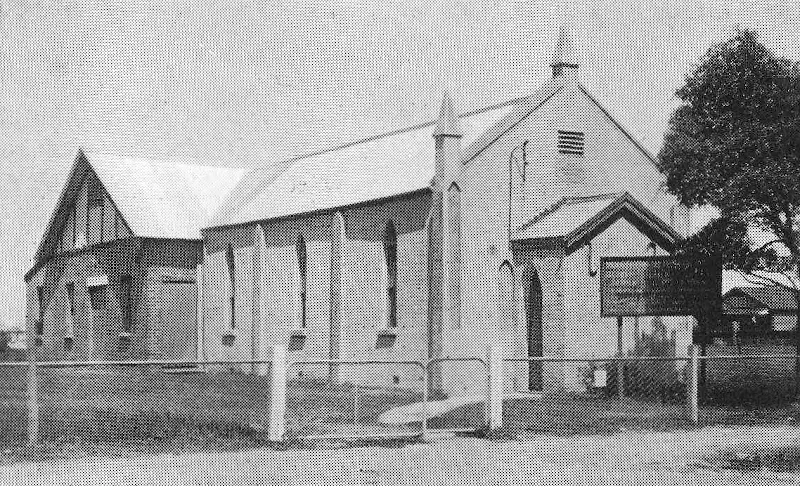
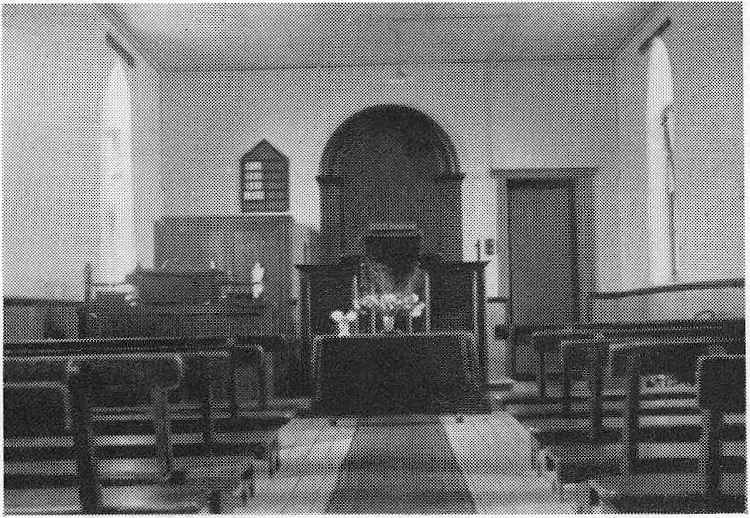
A year later the Reverend John Eggleston reported a brick chapel in course of erection, and in August 1852 it was reported as having been completed at a cost of £100. The original chapel, 25 feet by 18 feet, proved too small and in 1860 was enlarged at a cost of £80. The division in the flooring marking the site of the first development can still be seen. Various improvements have been made from time to time. In 1894 a galvanised iron roof was placed over the shingles by a band of voluntary workers under the supervision of David Jones who a few years earlier had erected the well-known landmark “The Towers” in Forsyth Street. At the same time the narrow galvanised iron lining the lower part of the interior walls was placed in position. About 1905 the Band of Hope collected £40 to defray the cost of the Wunderlich metal ceiling and the remainder of the walls were lined with the same material. With the exception of minor repairs to the floors and windows nothing further was done till 1921 when a kindergarten hall was erected by Mr Merrick (one of the trustees) at a cost of £120. Towards the end of 1930, an extensive program of renovation was undertaken when the roof, including the original shingles, was removed and the iron replaced, the Wunderlich metal lining which had become corroded over the years was removed and the upper part of the walls cement plastered. A further extension to the kindergarten hall was made in 1934. In 1940, a room was added to the kindergarten hall for use as a Bible study from older scholars of the Sunday School.
The earliest access is said to have been via the Punchbowl Road, though doubtless many tracks led through the timber, one in the general direction of Canary Road having been in use for 50 years prior to 1864. Between March and September 1841, Prouts Bridge was built across Cook’s River at Canterbury, and in 1843, Unwins Bridge at Tempe and both routes via Canterbury road and William Street appear to have been used. The same regular preacher when Moorefields was in the Newtown Circuit would take services at Canterbury, Parke’s home in Eariwood, Moorefields and Peakehurst. Even in recent times it was common for the same preacher to take services at Canterbury, Moorefields and Forest Hills (now Earlwood) in the morning, afternoon and evening respectively.
The 1840s saw the ferment of development as settlement began to push out from the town. In 1841, a dam was built across the mouth of the Cook’s River at Tempe, and the Sugar Company’s works (still standing) at Canterbury were completed in September of that year at a cost of £30,000. The Wesleyans were not behindhand and in 1841, a slab school house was erected there, used as a day school during the week, attended by about 40 children, and as a chapel on Sundays. By 1846, it was much dilapidated and was replaced by a stone chapel, which stands in Minter Street but, for some reason, vital Christianity did not take root in this centre. By 1851, there had been considerable growth and the census of that year showed the population of the Canterbury district, which apparently included Moorefields, as 473, of whom 102 were Wesleyans. This relatively large proportion of Wesleyans may explain the rapid development of Methodism in the area during the following few years.
The Moorefields School
From 1864 till the old public school was built in 1878, a day-school was conducted in the building under the auspices of the Wesleyan Church. The first teacher was thought to have been William Miller, succeeded by Joseph Saxby, a local preacher from Canterbury.
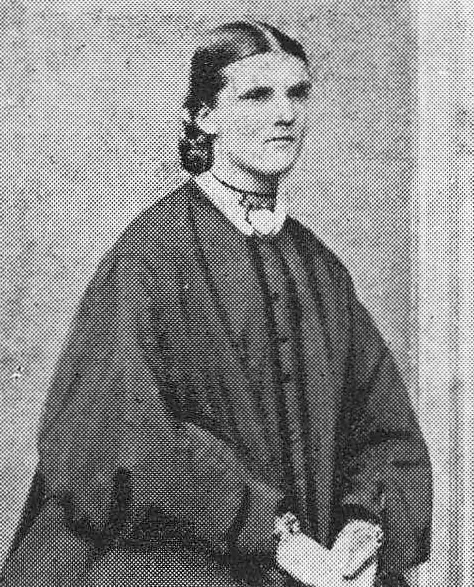
Sophia Ridgwell, the third day-school teacher, was keeping company with Francis Bemish who, on her death after two or three years teaching, continued with the school till the opening of the public school on its completion in 1878.
Although the Moorefields Church has always been in the Wesleyan and later the Methodist connection, for several years, about the early 1880s; the Salvation Army, under the leadership of Adam Bond and Susanna Parkes, held services in the church, and their ministry is still remembered with gratitude by some of the oldest members.
The Church Lighting
When first built the church was lit by candles, those on the pulpit being held by candlesticks fitted with jointed arms, which could be extended in any desired direction. A candelabra hung from the ceiling but this was taken down in 1884. and replaced by four kerosene lamps, two on each wall. In 1911 two “Miller” lamps, purchased from funds provided by a legacy of Mrs. Webb, augmented the lighting. In February 1923, gas was installed, and in 1929 this gave place to electricity.
The Church Furniture
Several interesting items of original furniture have been preserved through the century. These include a cedar table made in 1836 and given to Thomas Chád and his wife by James Chard. As no table was available in the church for the sacramental vessels, Mrs. Chard lent her cedar table and it has remained at the church and is still used. Most of the cedar seats in the church were originally backless forms. Much of the pulpit is original which the first congregations used though it has been altered somewhat from its original form. The candlesticks with extending jointed arms used on the pulpit are well preserved.
The Sunday School
The Sunday School is not quite as old as the church though there is reason to believe it was established by 1852. It is known to have been in continuous existence since 1859 when it is mentioned in the *Christian Advocate. The first recorded anniversary was held on 9 March 1864. Throughout its long history, this branch of Christian service has always been the most valuable and successful contribution to the church’s witness and the Master’s service. With the building of the kindergarten hall in 1921 it was possible to subdivide the school into two departments, thus giving more scope for this great work among the children of the district.
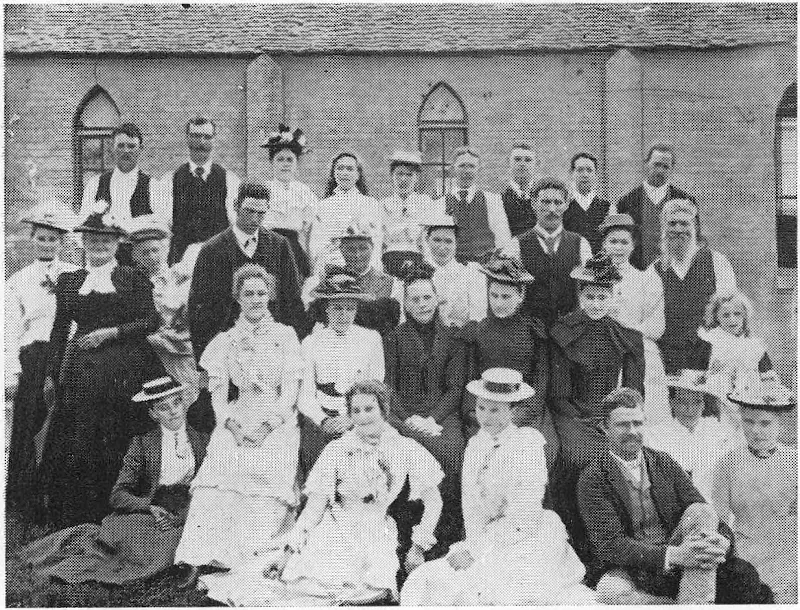
The Moorefields Church has had an eventful century of history. The same building has been in continuous use and the people have worshipped and served the same Master down through the long years.
The Moorefields Methodist Cemetery
It is estimated that about 1,000 burials have taken place in the cemetery adjacent to the church fabric. It is understood that the cemetery was available for burial purposes of all persons, irrespective of their denominational faith. A record of all the headstones erected in this cemetery and the inscriptions thereon, as far as can be obtained, was made in 1962. A copy of this record was provided to Ron Rathbone. In March 1968, portions of the burial ground were covered with brambles and other rough vegetation making a detailed inspection most difficult.
Most headstones are in good condition and quite legible, a few of the older ones have indistinct lettering and somewhat difficult to read, also a small number have fallen and are broken, but the graves are all known and names of those buried are in the records book. In some instances names of the headstones are memorials only, and the persons named are not buried in the cemetery. “A” section is the only one which numbers from Moorefields Road end, all the other sections number from the back fence. Additional details can be obtained by inspecting headstones and the record book. The inscriptions and photographs of headstones are also online at the Australian Cemeteries Index.
Within recent years the church building began to fail into decay. The roof sagged and water dripped through on to the congregation during wet weather, birds nested in every nook and cranny, and some birds were infested with lice, a circumstance which also tended to make the assembled congregation uncomfortable. Windows became loose in the brickwork, and white ants ravaged the floor and its supporting timbers. The trustees had repairs made from time to time, but the ancient church fabric was fast getting beyond repair. The Reverend Townsend, when preaching from the pulpit, had the misfortune to disappear from sight when the floor collapsed beneath him, much to the consternation of the congregation and, no doubt, the amusement of the termites.
There appeared to be only one remedy for this sad state of affairs and that was to erect a new church. The Methodist authorities in Sydney came to inspect the historic chapel and agreed with the trustees that the edifice was beyond repair and should be dismantled. Older members of the congregation were aghast at the proposal but, unfortunately, there was no other way out of the difficulty. The Reverend Alan Langstaff, who attended the church as a scholar, had the honour of conducting the final service in the old church on the evening of September 17, 1967. The building, now 117 years old, was later removed and it is pleasing to record that the original headstone of 1851 has been incorporated in the new church, which is to be erected on the site of the original chapel.
* “Moorfields” was renamed to “Moorefields” in the 1950s.
This article was first published in the April 1968 edition of our magazine.
Browse the magazine archive.