The Royal Commission into Noxious and Offensive Trades of 1883

by R. W. Rathbone

At a time when protection of the environment is a burning political issue, it is interesting to note that we, in this country at least, have been trying to clean up our act for more than one hundred years.

In the early 1880’s, Sydney was one of the most polluted cities in the world with an infant mortality rate equalling some of the most over-crowded cities in Europe. Much of the blame for this, fairly or unfairly, was levelled at the unhygienic Glebe Island Abbattoirs where the blood and offal of more than 600,000 animals a year was discharged in partially treated or raw form into Rozelle Bay, White Bay and Blackwattle Bay. The stench of rotting organic matter washed up along the shores of fashionable suburbs like Balmain and Glebe Point gave rise to heated complaints from adjoining residents and the site of their fine water views regularly discoloured by the huge quantities of animal blood discharged into the harbour did nothing to assuage their injured feelings while schools of man-eating sharks attracted to the area to gorge on the untreated offal only compounded their outrage.

Killing and dressing sheep at Glebe Abbatoirs, Australian Town and Country Journal, 7 June 1879.

Added to this, the unregulated establishment of slaughterhouses, knackeries, blood boiling, bone crushing, fell mongering, soap boiling, tallow melting, glue making and tripe boiling factories together with tanneries and wool scouring works in the heavily populated suburbs of Redfern, Alexandria and Botany were blamed for the regular outbreaks of typhoid fever which took a heavy toll of life in these areas every year.

The Government was aware of the problem but reluctant to act because, not only were the operators of these lucrative establishments able to bring pressure to bear for no action to be taken, but it simply did not know what to do with all this waste matter if the factories which processed It were to be closed down.

Alfred R Fremlin 1880 (courtesy State Library of NSW)

In the Summer of 1382 a severe outbreak of typhoid fever in the suburb of Redfern which resulted in the deaths of over one hundred people caused the district’s parliamentary representative, Alfred Reginald Fremlin M.L.A., to demand that an area of land, within easy access of Sydney should be set aside to accommodate the activities of all persons engaged In noxious and offensive trades. The Legislative Assembly went even further. It set up a Royal Commission under the Chairmanship of Hon. John Stewart M.L.C., a man of independent liberal principles, a noted veterinary surgeon and a former Professor of Veterinary Science at the University of Glasgow before he emigrated to Australia.

The Commission invited submissions from all interested parties and toured extensively those establishments on which it was required to report. Its description of the conditions which prevailed at the Glebe Island Abattoirs is lurid in the extreme and suitable reading only for those with a very strong stomach and it will suffice to say that as a result of the report of this Royal Commission, the Glebe Island Abattoir was eventually closed and its operations moved to Homebush Bay.

The Commission’s comments on the establishments it visited at Redfern, Alexandria and Botany also make colourful reading but are beyond the scope of this essay.

Boiling down establishments, knackeries, slaughterhouses and fertilizer works also dotted the landscape of the infant Municipality of West Botany, particularly along the courses of Cook’s River and Wolli Creek, Muddy Creek and Patmore’s Swamp and had been a persistent source of complaint ever since the Council had been incorporated. As early as March 1872, Mr. William Bucknell complained about the activities of Messrs. Garden, Staples and Nelson in Arncliffe and the following month a complaint was received about the boiling down works and slaughteryard conducted by Mr. Joseph Davis which was described as “a common nuisance and decidedly injurious to the health of local Inhabitants”. But as three of the six aldermen of the Council also conducted boiling down works as profitable sidelines to their other activities, it was, perhaps, a little optimistic to expect any concerted action to be taken to suppress them.

Mr. William Bucknell, however, was not a man to be put off and in November 1872, he not only demanded that Mr. Garden’s boiling down works be closed but produced a doctor’s certificate which stated categorically that “the effluvia arising from decaying animal matter on these premises is highly injurious to health”. In the face of this evidence, the Council decided to ask Mr. Garden to desist. It was February 1874 before Mr. Bucknell again approached the Council this time complaining about “the small from offal at Morrissey’s”. The Mayor, Alderman Elias Godfrey, took it upon himself to personally investigate the complaint. His subsequent report to the Council that Mr. Morrissey’s piggery, boiling down works and slaughterhouse were remarkably clean considering the state of the weather and that he had found no offensive small arising there from and considered great praise was due to the owner for the clean state in which he kept his premises was, perhaps, a little too emphatic as the Mayor himself operated the largest and most offensive establishment of this kind in the Municipality. Throughout 1875, 1876, 1877 and 1878 the Council received numerous complaints “calling attention to the stenches arising from the piggeries and boiling down works in the neighbourhood of Arncliffe” and ultimately, in 1879, it decided to appoint Mr. David Hannam Jnr. as its first Inspector of Nuisances.

It was then, little wonder that the Royal Commission on Noxious and Offensive Trades decided to include an Inspection of the Municipality of West Botany in its investigations. The Commission visited this area in February 1883. It first inspected Mr. Barden’s boiling down works on the edge of Patmore’s Swamp at Kogarah where there were five boilers, one digester and a bone mill driven by steam. It was described as generally clean with the buildings in fair repair supporting 16 pigs and 100 head of poultry. It processed six tons of offal a week producing 15 hundredweight of tallow and one ton of bone dust.

Mr. William Humphries’s poultry farm off James Street also passed the scrutiny of the Commission. Here there were three boilers that worked continuously processing 7 tons of offal to support 1,500 ducks which in turn produced I47 dozen eggs per week. These premises also produced three hundredweight of tallow. The buildings were described as primitive but in fair repair and passably clean as a result of which very little stock was lost by disease.

Mr. Robert Beehag’s poultry farm near the intersection of Bay Street and Rocky Point Road was also inspected. It, too, was described as “generally clean” and the buildings in good repair. The Commission appeared to be more interested in the fact that with the coming of the railway, land occupied by George Francis’s duck farm near Lady Robinson’s Beach, had increased in value from £100 to £1,500 in a matter of months though it did mention that he raised one thousand head of better class fancy fowl, game, Spanish, bantam and brahms, edible pigeons and superior ducks. He also had twenty pigs which, in the above company, we must assume to have been of above average quality as well.

It was, however, when the Commission arrived in Arncliffe that its visit to the Municipality of West Botany really became worthwhile. Mr. D. Chappelow’s poultry farm In Arncliffe Street was described as “dilapidated and not very clean” and the methods employed as “primitive”. This farm had the highest mortality among its fowls of any premises the Commission had seen and the four boilers gave off a most offensive odour while Mr. David Tuck’s establishment on the banks of Wolli Creek “stunk as bad as anything (the Commission) had yet seen” and was the filthiest they had ever witnessed. The Chairman reported “the fumes from this place adhered to my clothes for many hours, beyond a doubt and I brought the abominable stench with me some 10 or 12 miles back to Sydney”.

Henry Nelson’s establishment nearby, which contained five boilers was also described as “very dilapidated and dirty” whilst Henry Latham’s piggery and boiling down works adjacent to the Illawarra Railway works was described as “being in such a filthy state as to be scarcely expressible with an abominable stench produced by an accumulation of slush and dirt”.

It was not until they got to Godfrey and Moon’s Boiling Down Works just off Rocky Point Road that the Commission was really able to give full vent to its collective outrage. This dreadful establishment, which processed the offal from some 50 of Sydney’s butchers shops produced 5 tons of tallow and 100 tons of bone dust a week. It also boiled down on Instructions from the police, most of Sydney’s unwanted dogs, goats and other discarded domestic animals, their skins going to the nearby tanneries at Botany while their fat was used to dress leather and to make candles. The stench from this enterprise was described as “abominable and foul beyond description”. The Commission concluded that boiling down works were natural, necessary and profitable and a major health hazard would be created if they were closed down as the 362 tons of offal generated each week in Sydney could not be disposed of except at great public expense. It recommended that a suitable area of land a moderate distance from the city and accessible to a railway line should be set aside as a site for all Sydney’s noxious and offensive trades.

The Industries were to be located “where they might be guaranteed against disturbance and where space around them can be provided so that they might give no offence to any existing population”. The site also required a position where a prevailing north east wind carried any odours over uninhabited land.

Sites at Long Bay and Botany were ruled out because the land was too valuable. An area on the southern side of Botany Bay was excluded because it was too inaccessible. The Commission therefore plumped for a site on the Port Hacking River adjacent to the National Park.

This site involved the construction of 12 miles of railway tracks to link it with the main Illawarra Railway Line and a jetty into Port Hacking itself. That was enough to make the Government lose interest and instead it resolved to set aside 432 acres of the Sans Souci Peninsula which the Commission hadn’t recommended as the site for all of Sydney’s noxious and offensive trades. The decision created uproar in the Municipality of West Botany, even those aldermen who stood to gain financially condemning it in the strongest terms.

But all the protestations of the Council would not have saved the day had It not been for the fact that Hon. Thomas Holt M.L.C. owned practically all the land that was to be resumed. Holt not only had many influential friends In high places but had bailed out the impecunious Premier, Sir Henry Parkes, on a number of occasions when that eminent gentleman was facing bankruptcy and in the spirit now well entrenched in N.S.W. politics, he decided to return his friend’s favours by officially abandoning the proposition in April 1887.

Thus, no site was ever set aside. The Glebe Island Abattoirs continued to pollute the waters of Sydney Harbour for another thirty years and only improved technology eventually made the stinking old boilers redundant.

This article was first published in the July 1990 edition of our magazine.

Browse the magazine archive.

Kingsgrove Gasometer Demolished

by B. J. Madden

Mid-November 1979, saw the demolition and removal of a landmark in Kingsgrove – the Gas Holder in Kingsgrove Road opposite Omnibus Road. The Gas Holder was built during 1926-27 in order to improve the gas supply in that area, which was then undergoing rapid expansion.

The Holder had a diameter of 164 feet and fully inflated was approximately 114 feet in height.

At 6am on 15 February 1956, the early morning quiet was shattered by ‘a muffled roar’, a ‘great flame shot into the air’ and residents thought that a bomb had exploded. The ‘muffled’ sound was the roar of flaming gas escaping from a major leak at the top of the container. Four residents suffered superficial burns. The Australian Gas Light Co., explanation of the incident was that it was not an explosion in the true sense of the word but was caused by failure of the crown. A ring of corrosion had formed around the periphery of the crown, causing the metal to part and the crown to open up in much the same fashion as the lid of a jam tin. The escaping gas ignited in the atmosphere causing very little damage. The Holder, without the support of the containing gas simply fell into the underground tank.

The Company decommissioned the holder early in 1979 when it began to pump processed natural gas into the Kingsgrove area from the Holders at Chullora. There is a photograph of the framework of the Gas Holder being demolished in the St. George and Sutherland Shire Leader of 21 November 1979.

I was able to obtain some photographs on 15 November 1979, just after demolition had commenced. The Australian Gas Light Company has been unable to locate old photographs, and I wonder whether there are any photographs of the Gas Holder or of that part of Kingsgrove on the northern side of the Tempe-East Hills railway line, which would give an indication of the size of the Gas Holder. It would be particularly interesting to see photographs taken before World War II and I would appreciate the opportunity to copy any such photographs.

Update (November 2025): Thanks to Michael Murphy for this photograph taken in the 1950s from a home on the corner of Kingsgrove Road and Kingsgrove Avenue:

This article was first published in the February 1981 edition of our magazine.

Browse the magazine archive.

Lydham Hall Historic House Museum

by Tina Workman

The St George area was very fortunate that Rockdale Council had the foresight to purchase a stone cottage called Lydham Hall many decades ago with the sole purpose of conserving this beautiful old house which, in turn, would provide the area with a local history museum and a home for the St George Historical Society. It was purchased for $26,000 and opened as part of the Rockdale Council’s Centenary Celebrations in 1971.

Lydham Hall is a sandstone villa built circa 1860 for businessman Joseph Davis, his wife Ellen and their family. The house was part of a 67 acres estate that Davis called ‘Lydham Hill’, built on the highest ridge in the area and with commanding views of Botany Bay. Davis had a butchering business in Newtown and used the property to fatten up his cattle before slaughter.

The original house consisted of 4 large rooms coming off a central hallway, surrounded on all sides by a generous verandah. When Davis died in 1889, the property was subdivided and a smaller parcel of land was sold to local oyster farmer, Frederick Gibbins, who leased the property to a succession of wealthy tenants.

In 1890, the house stood on three and a half acres surrounded by outbuildings, paddocks, orchards and with rugged vegetation beyond. In 1907, Gibbins’ daughter, Ada, married renowned naturalist, David Stead. Stead was a widower with a young daughter, Christina, and the family occupied the house with their growing brood of children, Stead’s sister and her daughter.

Christina Stead would go on to become an important, internationally acclaimed author who included references to ‘Lydham Hill’ and the rounding area in a number of her books and short stories. The Stead family lived in the house until the death of Frederick Gibbins in 1917.

After Gibbins’ died, the house, as well as sections of the property, were further subdivided and a succession of owners and tenants lived at Lydham Hall until 1958. Up until that stage, the property still had substantial outbuildings to the southern side including stables and a large kitchen.

In 1917, part of the verandah on the southern end was demolished to create additional rooms which were used as a bedroom and a bathroom. There is also evidence of ‘lean-to’s’ built under the verandah on both the eastern and the northern sides.

By the late 1950s, all remnants of outbuildings were gone and the property was subdivided again, until only 1,300m2 of land was left. This was to be the last subdivision.

An aerial photograph of the house in the 1940s shows the house with stables, kitchen and other outbuildings on the property.

In 1958, the house was purchased by George and Valmai Long who lived there, as caretakers, long after it was sold to Rockdale Council.

The house in the early 1960s

On acquisition, the Society began the mammoth task of restoring the house, furnishing it and gathering enough objects to create a folk museum in the upstairs attic rooms. When the house officially opened in February 1971, only 2 rooms and the hall were open to the public. The other 2 rooms, the attic and the 1917 rooms were still occupied by Mr and Mrs Long and their family. Regardless, in the first year of opening, approximately 1,700 visited the house with the house charging 20 cents on entry.

Opening invitation

The house soon found itself in a position of having too many objects and not enough space to display them. The lack of space saw the Society knock back several objects of importance, including a desk owned by David Stead, one of the original occupants of the house.

Mayor Ron Rathbone officially opening the museum in 1971

In 1972, the house was offered a large loan of furniture from the National Trust which required substantial space. The attic was vacated by the caretakers the following year and the additional space meant that the Society was able to renovate the upstairs rooms for the display of donated objects. These rooms currently display over 1,500 objects of local and historical interest.

In 1978, a new wing was built to accommodate a new caretaker. This wing included a bathroom and kitchen as well as toilets for visitors.

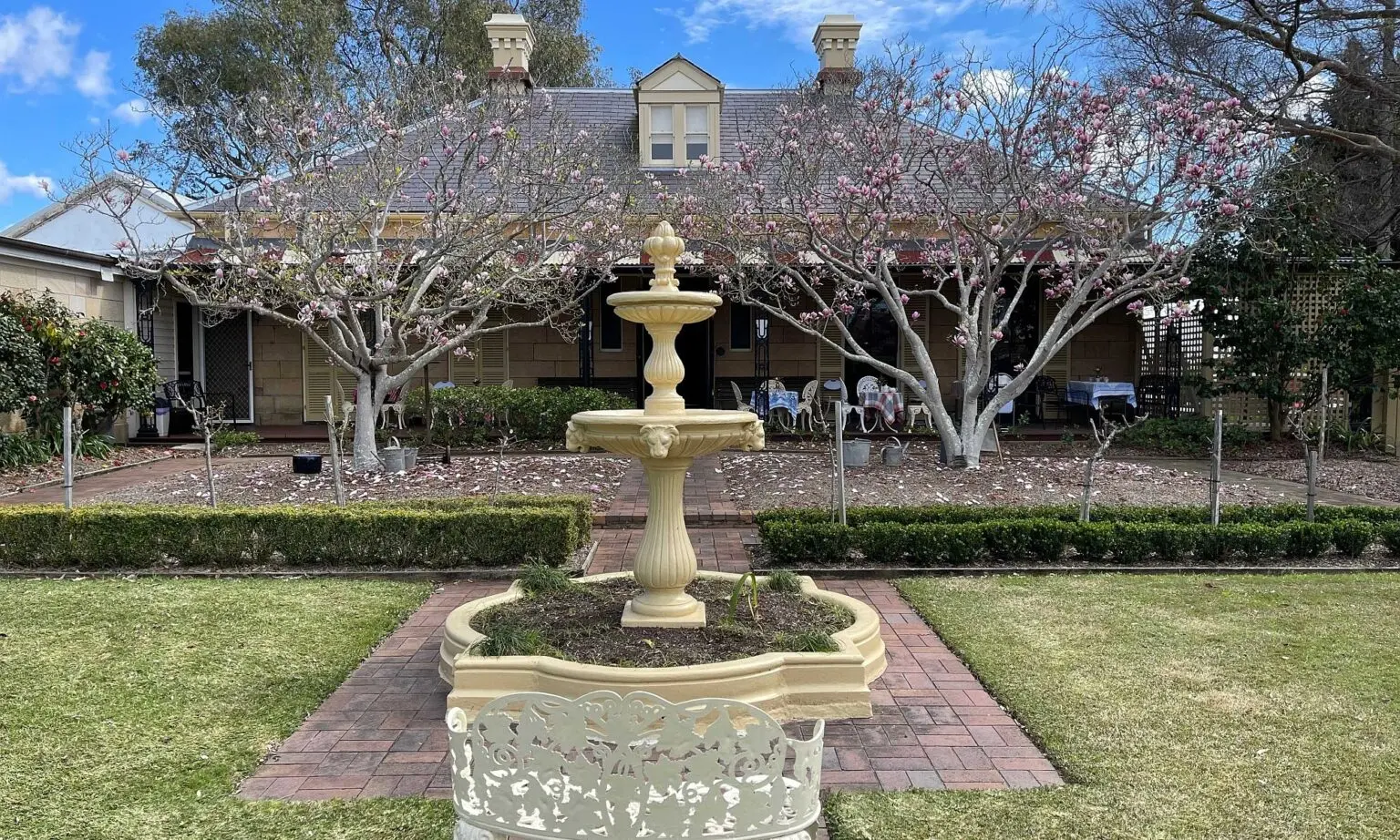
Magnolias in bloom in the back garden

Today the house still sits proudly on 1300m2 surrounded by manicured, modern gardens and is regularly open to public. Throughout 2020 and 2021, the house has undergone extensive renovations which have included refurbishment of the existing slate roof, replacement of the verandah roof, repairing the verandah decking and repainting of the exterior in colours that reflect the period of the house. The house will reopen in 2022.

Stage 1 Restoration of Lydham Hall

Anyone who owns an old house will appreciate that restoration and maintenance is an ongoing process.

The last major restoration for Lydham Hall occurred in the 1970’s when Rockdale Council first purchased the house. Minor works were done as required and then, in 2015, a storm caused extensive damage to the roof of the house and interior spaces. Whilst this was repaired at the time, major restoration was required to stop further damage.

Image showing some roof damage prior to the refurbishment (photo courtesy of Heritage Slate Roofing, Sydney)

In 2019, Bayside Council successfully applied for funding from the State Government for restoration works for Lydham Hall. A new Conservation Management Plan was written and, after delays due to Covid-19, work commenced in October 2020.

Work commences in October 2020

Stage 1 works included:

  • refurbishing the existing slate roof with new battens, sarking, flashings, gutters and downpipes on the original stone residence building;
  • reconstruction of the timber framing, flashings, cladding, sarking, internal lining and roofing to the two dormers;
  • removal of the dilapidated shed in the backyard;
  • replacement of the verandah sheeting and painting of the dormers, chimneys and verandah posts.
New ridge capping being installed on the dormers (photo courtesy of Heritage Slate Roofing, Sydney)

Before work could commence, the Society, together with the members of the Lydham Hall Management Committee, had the task of removing all of the objects in the upstairs museum and securing furniture in the rooms impacted by the works. Many objects were washed, wrapped, transported downstairs and boxed for storage. The important task of cataloguing the collection, which had started some months earlier, was put on hold as the house would be inaccessible until work was completed in 2021.

BEFORE: the images above show missing, broken and loose tiles. The windows, fascias and timber sides of the dormers were rotted and allowing water into the house. The house in the 70s had been painted all white and new decorative fascia and finial added. The tree overhang had caused blockages in the gutters and downpipes.

(photo courtesy of Heritage Slate Roofing, Sydney)

AFTER: All the slate tiles were lifted, checked, cleaned and replaced. New tiles were brought in where required. New ridge capping installed and the corrugated iron verandah sheeting replaced. New timberwork on the dormers and chimneys painted to colours more appropriate to the period (taken from paint scrapings).

(photo courtesy of Heritage Slate Roofing, Sydney)

The colours at Lydham Hall

In the 1970s, the Council and the St George Historical Society undertook the major restoration of Lydham Hall. As part of that restoration, external elements of the house were given a new coat of paint and all the walls inside were painted or wallpapered. Existing carpets were removed and replaced with new, and the black and white check linoleum flooring was laid in the hallway. Unfortunately these finishes were selected without any research into what colours may have been originally used in the house nor any research into what colours would have been correct for the period.

Paint scrapes taken on the exterior show a variety of different colours dating from the 1860s through to the 1960s.

As part of the 2020 restoration, a heritage architect was contracted to review the finishes and to undertake the task of carrying out paint scrapes. The scrapes done on the exterior windows and shutters showed a variety of potential colours. The next stage would be to decide on a final colour scheme – no easy task when the various stakeholders had strong and differing opinions! It was decided to paint sample colours of all the possibilities, on the house itself, in order to see how the colours looked in situ. Below is a selection of images showing the various permutations:

In September 2021, a final scheme was agreed on and approved by the architect. This scheme is fitting to a house of the 1860s and matches the colour scheme already painted on the top of the house as part of the Stage 1 works. The rendered image below shows colours for the final scheme selected.

However, the selection for colours for the interior has proven to be more elusive. Initial research revealed only a single layer of paint in all rooms with original plaster underneath. This implied that the house had only ever been painted once since the 1860’s.

The floor boards in the attic proved this theory incorrect. When the carpet was lifted in one of the rooms, an abundance of colours were revealed. These paint splashes had been deposited over many decades of painting. Fortunately, the floorboards in the attic rooms, unlike the ground floor rooms, were not sanded and polished so they revealed paint colours in different whites, pastel pinks and green to vibrant reds, greens and dark browns.

Floor boards in one of the upstairs attic rooms reveals a myriad of different colours that would have once been painted on the walls.

This suggests that this room, at least, had been painted multiple times despite none of these colours appearing on the walls of the house.

The mystery was solved when old meeting records were reviewed. In the November 5th 1974 meeting records for the Lydham Hall Committee, “Alderman Ron Rathbone expressed concern that no work had yet been undertaken in the bedroom. Two painters he had rung had refused to quote because of the amount of stripping that was involved.” Some months later, a company of painters were found who were willing to undertake the task and, sadly, over 100 years of historical fabric was stripped from the walls.

Further research and investigation will involve removing skirting boards and architraves around doors and windows to see if there are any remnants of historic wall paint colours or wallpapers. This research will have to come later, when future funding becomes available. In the meantime, the house interior will be repainted, with the approval of the heritage architect, in neutral colours suitable for a temporary scheme for a house of this period.

The wallpaper in the upstairs rooms and in the dining room will also be removed as part of Stage 2 renovations. These wallpapers were applied in the 1970’s and are now in poor condition. The walls will be temporarily repainted in preparation for the house re-opening in 2023. The wallpapers in the other rooms will remain in place until further funding becomes available.

Wallpaper in the attic rooms being removed from the walls in preparation for new paint.

Cleaning the collection at Lydham Hall

In early 2020, the task of cleaning and cataloguing the collection at Lydham hall was being planned, and had just started, when Covid-19 arrived.

Since then, the museum has only been intermittently accessible to volunteers between State lockdowns and renovation works so the project has been extremely slow. However, some progress has been made.

The objects in the upstairs museum needed to be relocated to allow access to builders to the roof and attic. Volunteers took this opportunity to wash and box up the crockery, silver and glass in the display cabinets for temporary storage downstairs. Many of these objects hadn’t been cleaned for many years and the high humidity and leaking roof had left the items dirty, dusty and mouldy. Once work on the roof had been completed, these objects were unpacked and stored upstairs ready for the task of cataloguing them.

The silver and metal objects in the collection are also in the process of being cleaned and catalogued. Because of the damp conditions, some of these items were so badly corroded and tarnished that they were unrecognisable. The long arduous process of cleaning these may take some time.

Before & After: The difference a good clean can make.

The Society also has a large collection of textiles ranging from bedspreads, supper cloths, doyleys, dresses and a large collection of nightwear, underwear and children’s wear. Many of these were in poor condition when they were donated, and the environmental conditions inside the house have made them more susceptible to mould and insects.

The large dining room table laid out with doyleys, all ironed and sorted. Shown here is only a selection of the total collection.

The volunteers started with the easy textiles – doyleys. There were hundreds of them! Some old, some in fragile condition, but most were in good condition. They were all inspected for condition, age, tears and stains and washed or treated accordingly. The same routine was applied to the white linens (underwear, nightshirts and children’s dresses) and bedcloths. Items too fragile to wash have been stored until they can be conserved professionally and will be reviewed for future care.

All the whites hanging to dry after washing. Next step, ironing!

One large fabric object was deemed too important, too large and too fragile to keep at Lydham Hall. This object was the Bexley Public School Patriotic Appeal Flag – a rare and significant object from the first World War.

A funding-raising project in support of the war effort, the flag is embroidered with 59 names of local residents who donated to the appeal.

The flag was donated to Bayside Council who has cleaned, repaired and conserved this valuable object and it is now on display in the Rockdale Town Hall foyer.

Books cleaned, sorted and ready to be catalogued.

Books are another object in abundance at Lydham Hall, including a huge collection of Bibles and religious books. Like the textiles, many of these were donated in poor condition and are also affected further by humidity and insects. Volunteers are in the process of cleaning, reviewing, sorting and cataloguing these.

Cataloguing in progress

It is anticipated that the task of cataloguing the collection fully may take a number of years. Once the house reopens properly and the Society can gain full access again, volunteers will be called on to help.

Council staff installing the Bexley Patriotic Flag. Photo: Bayside Council

Kingsgrove

by B. J. Madden

Kingsgrove was the site of a factory for the manufacture of tobacco and snuff for about 20 years from 1854. Thomas Smithson was a native of Leeds, Yorkshire (born c 1814). He and his family are said to have arrived in Sydney on the ship Ascendant in 1852, and resided at Paddington for a couple of years. He had been engaged in tobacco manufacturing in England and it is said that he was associated with Hugh Dixson prior to coming to Kingsgrove. Hugh Dixson had founded the Dixson Tobacco Co Ltd. which eventually became British Tobacco and is now Amatil. his grandson, Sir William Dixson, established the Dixson Collection which is associated with the State Library of New South Wales.

After leasing the land for a year, Thomas Smithson purchased Lot 11 of 25 acres at the corner of Stoney Creek Road and Croydon Road in December 1855, although it was mortgaged back to Michael Gannon at the same time. The tobacco factory was on the southern side of Stoney Creek Road about half way between Caroline St and Kingsgrove Road and most of the Sydney Houses were supplied with snuff and tobacco. The tobacco leaf was said to have been grown on the property. One of his granddaughters was taught by her mother to plait her hair in six strands, which was the way they plaited the tobacco.

After operating the factory for 20 years, Thomas retired. Incidentally, the land as re-possessed by Michael Gannon because of money owing. Thomas died at his residence in Stoney Creek Road on 26th June 1908, but his residence at this time was at the rear of his son’s house, which is where the Bexley Golf Clubhouse is now located. The Sydney Morning Herald on 1 July 1908, reported that the funeral, which took place at Moorefields Cemetery on Sunday 28 June 1908 was one of the largest seen in the district, and was attended by many old residents. Thomas Smithson’s descendants were said to number 122, and he was 94 years of age at the time of his death. He was one of the first road trustees for the district, a position he held until his death. (This would probably refer to Stoney Creek Road, which was planned 1865 and opened 28th July 1868).

In the item concerning his death in the St. George Call of 4 July 1908, it was said that he could relate many incidents of the early days when the settlers, anxious to make a decent road to Sydney. brought their own saplings and laid the first corduroy track, giving an approach to Cooks River. Smithson’s Wine Bar, run by Thomas’ son James Edward Smithson, is a separate story.

Smithson’s Wine Bar, Stoney Creek Road (courtesy Bayside Library)

This article was first published in the February 1981 edition of our magazine.

Browse the magazine archive.

Lydham Hall

by Valmai Long

Cedric Emanuel sketch of Lydham Hall, Lydham Avenue, Rockdale (courtesy Bayside Library)

Joseph Davis built “Lydham Hall” on Lydham Hill when he purchased 68 acres of the original land grant given to James Chandler by Governor Brisbane.

Joseph Davis (courtesy Bayside Library)

This was the first subdivision of Bexley. Large blocks of sandstone were hauled uphill to the building site from the quarry, now the corner of Villiers Street and Arlington Street. All interior woodwork is cedar, originally hand polished, and the marble carrara fireplaces were imported from Italy. James Benson was the stone mason and like most of the early settlers, related to Granny Parkes.

The coach entrance at the junction of Forest Road and Clarence Road, was the scene of one of Bexley’s biggest social nights, when Joseph Davis gave his housewarming.

Carriages swept down the circular driveway to the front entrance (now the rear of the home) and were greeted by an orchestra engaged for the occasion.

The “Lidham Hill” mazurka was especially composed for the opening and the music is still kept at “Lydham Hall”.

Joseph Davis was a butcher and drove his cattle overland from Homebush to the waterhole (now the corner of Herbert and Tyrrell Streets). After resting in the paddocks they were taken to his slaughter yards at the Earl Park site at Arncliffe.

The Davis Butchering Company, King Street, Newtown (courtesy Bayside Library)

Joseph Davis and his family were unfortunate. His son Frederick born a cripple died at 15 years of age. Joseph became paralysed after lifting a side of beef. He drove around the district in a converted victoria, in a reclining position.

He is buried in the family vault at St. George Church of England, Hurstville, with his wife and son Frederick.

Today footsteps are often heard pacing the floors and treading the stairway. One foot drags as though a cripple is walking. The ghost is affectionately called Joseph by the owners, Mrs. Long is confident Joseph is looking for his money, which was never found after his death. No domestic animal will stay in the house when the ghost walks.

The surrounding streets are named after his sons Frederick, Herbert, Oswell, Stanley (now Tyrrell), Joseph (now Lydham Avenue) and Clarence for his daughter.

A later owner James Stead, was a botanist and named Banksia Station.

He kept a zoo and emus and kangaroos and fine bloodstock was bred on the hilltops. Stead imported stock from his stud farms in New Zealand. The animals were better housed than a lot of humans. Their home had glass windows, cedar shutters and an underlay of bitumen to the iron roof. It still existed until the 1950’s. The old water wells were turned into snake pits. Men today, tell me how as boys, they stoned the snakes, and were chased up trees by the horses.

One dry summer the local housewives were kept on their toes, when two snakes escaped from the snake pit.

The kitchen garden which supplied the home with fresh vegetables was the corner of Lydham Avenue and Herbert Streets (opposite side to Lydham Hall).

Dr. Gordon Craig a former owner, in later years was appalled to see the estate cut up and built on.

The traffic in the early days were mostly timber getters and baker’s carts. They rumbled along in their juggernauts at night, lighting the way with a candle in an inverted bottle.

One man out courting was treed all night by the wild dogs in the Old Forest Road.

Joseph Davis was a founder of Christ Church Bexley and old Bexley School. This caused a bitter comment from the headmistress of Kogarah School, who accused wealthy landowners of trying to boost the sale of their land. Her school being capable of handling the population.

Many attempts have been made to demolish “Lydham Hall”.

It was recently described by a visitor from the ‘National Trust” as a jewel and a treasure hidden for years.

The Royal Australian Historical Society called there on their first official visit to the St. George District and regularly since. Other visitors have been St. George Historical Society, Parramatta Historical Society and Bankstown Historical Society.

Sketch by Gifford Eardley

“Lydham Hall” is on “Robinson’s Map of Historical Homes and Landmarks”.

It has one of the finest panoramic views of Sydney. Being on one of the highest ridges between Cooks River and Georges River, it has been unspoilt by Sydney’s skyscrapers and home units, as it overshadows them. Recent additions to the view are Gladesville Bridge and new T.C.N. tower. Now Roselands claim to have the highest point but Lydham Hall’s view stretches miles beyond.

A former owner protected the view by placing a covenant on homes built at the rear, when he subdivided. They are not allowed to build more than one storey.

Strange the view should be protected by a blind man. Could he see more than we can today?

This article was first published in the September 1970 edition of our magazine.

Browse the magazine archive.