When I was eleven and in Year 6 at Carlton Public School, my father, a successful businessman, decided it was time “I learned the use of money”. I am not sure whether he attributed his success in business to the fact that when he was growing up he had been a paper boy but that was the future he had mapped out for me and once my father made a decision that was that.
Carlton Public School, Cameron Street, Bexley (Courtesy of Bayside Library Service Local History Collection)
I was duly presented before Mr. Cooper of Cooper’s News agency in Carlton Parade who, I suspect, had some reservations about the latest addition to his team of paper boys but he agreed to give me a go.
My run took me along Carlton Parade to Grey Street, up Grey Street to Ethel Street, along Ethel Street to Willison Road then back down Willison Road and Short Street to Carlton Parade. It was supposed to return me nine shillings a week less any uncollected debts.
In those days there were two evening newspapers, The Sun and The Mirror, the Women’s Weekly which appeared weekly and a host of women’s magazines. While the nine shillings gave me a degree of financial independence, it was the powerful Thunderer whistle which was an essential piece of your equipage that was the real attraction of the job.
Among my customers was a somewhat confused, middle aged, grey haired lady who wore unfashionable long dresses and took a copy of almost every publication I carried. Unfortunately, she could never find her purse to pay for them. Despite my beloved Thunderer which I ceased to blow as soon as I turned into Grey Street and my efforts to get past No.26 before the owner appeared, my attempts at financial debt containment were to no avail as she was always sitting on her verandah, hiding behind the fly wire door or standing just inside the front gate waiting for me to appear. According to her neighbours she was a harmless old eccentric who wrote poetry and was a bit soft in the head.
The net result of all this was that by the time my uncollected debts were deducted from my nine shillings each Saturday, I was lucky if I was left with five shillings.
Years later I won a scholarship to the Teachers’ College where one of our compulsory subjects was Australian Literature. It was while I was there that I discovered the impecunious old lady whose reading matter I had subsidised during my time as a student at Carlton Public School was none other than Stella Miles Franklin, Australia’s most outstanding woman novelist and a lady who enjoyed an international reputation for her writings.
There also lived in Carlton in the large two storey terrace type house on the corner of High Street and Carlton Parade another remarkable old lady. Her name was Miss Nellie Battye.
She had worked as a receptionist for a group of doctors until she was 80 and had then donated her services to the City of Sydney Eisteddfod where she inscribed the various certificates in her immaculate copper plate writing. She had been a member of the Fourth Ward Progress Association for a number of years and at the age of 84 joined the Carlton-West Kogarah Branch of the Liberal Party where she filled the vital position of Whip in the Branch’s debating team in the fiercely contested competition each year with other Liberal Party Branches in the area.
A pillar of the Carlton Methodist Church and a great supporter of the Wesley Mission, she fell down the stairs of her home on one occasion and broke her hip. When I visited her in Prince Alfred Hospital she was sitting up in bed reading the raunchy American novel “California” and declaring to anyone who would listen that she was a fraud who should have been sent home as there was nothing the matter with her.
Carlton Methodist Church (Courtesy of Bayside Library Service Local History Collection)
One day I was telling her about my experiences with Miles Franklin whereupon she produced an early copy of “My Brilliant Career” the novel that first brought Miles Franklin fame signed Stella Miles Franklin and insisted that I keep it.
It is still one of my most treasured possessions.
This article was first published in the January 2014 edition of our magazine.
John Joseph Murphy was born at Concord, New South Wales, in 1869. He was born with a great love of horses, which was to remain with him all his life. As a young man he entered the Meat Trade, in the beginning carting meat, and gradually learning every phase of the business over several years. He then entered into business in the Wholesale Butchery on his own behalf. Mr. Murphy was most successful in his enterprise, which he carried on until he retired in later life. He made a great deal of money out of it.
Margaret Prosper was born at Wattle Flat, 25 miles out of Bathurst, in 1868. Her father (who was French by birth), whilst ploughing his paddocks one day turned up one of the largest nuggets of gold found in Australia It was known as the “Prosper” Nugget. As a young girl Margaret came to Sydney to live, and later she met John Murphy. After they had known one another a short time, they married at St. Thomas’ Church, Lewisham.
After their marriage they went to live in Queensland, where Mr. Murphy had work. Eventually they returned to Sydney to live, settling at Rozelle. Mrs. Murphy went home to Bathurst for the birth of their first child, a son, whom they called Cedric. Three years later they were blessed with a daughter, whom they christened Violet Marguerite. The family lived at Rozelle for about 15 years, and then moved firstly to Five Dock and then Leichhardt for a short time, and then in February 1906, they moved to Arncliffe. Here they lived in a two storey stone house situated on the Highway, near Arncliffe Station. The house had been built by a “Cousin Jack” (a Cornishman), who had at one time been an “Admirer” of Mrs. Murphy. It was said that the gentleman had died in the house, and this made Mrs. Murphy feel uneasy and unhappy, so eventually they moved in September, 1907, to that delightful cottage “Mimosa”, on Forest Road, Bexley, right opposite the street also bearing the name “Mimosa”.
“Mimosa” in Dowling Street, Arncliffe (Courtesy of Bayside Library Service Local History Collection)
“Mimosa” was originally built for Mrs. Clune, widow of Dr. Clune, and has white washed walls and grey slate roof, with cast iron columns supporting the roof of the front verandah. The windows are those quaint many pained modified Gothic type. On either side of the Gate Posts stood Pine Trees, which gave the impression that they were guarding the driveway to the house. Today “Mimosa” has a modern fence and garden.
Mr. Murphy used to deal in horses, which he bought sometimes at sales in the Metropolitan area, and sometimes in the country. Some of the horses he kept for his own use, and others he sold. The horses were kept in paddocks adjoining “Mimosa”. On one occasion his son Cedric, went to the Country and brought back 15 horses. There was always a demand for horses in those days, by both the Business Merchants for their drays, etc. , and also by private people for their sulkies, etc.
At this time Mr. Murphy had the Slaughter House at Bestic Street, Rockdale. It had formerly been Whitby’s Slaughter House. The drovers used to bring the cattle down to a paddock in Gibbes Street, in the late afternoon, where they would remain until the early hours of the morning, when they would be taken down to the Slaughter House and killed.
Muddy Creek from bridge at Bestic Street, circa 1910 (Courtesy of Bayside Library Service Local History Collection)
When the Murphy family went to live at “Mimosa” there was a horse-drawn bus service operating from Mimosa Street to Rockdale Station. It was owned by an old man named Joe McGrath, who lived in Mimosa Street, near Downey Street, Mr. McGrath’s Bus Service failed, in fact he went broke, and the business was put up for auction. Mr. Murphy attended the Sale, and so that Mr. McGrath would not lose everything, he “bought the buses in”, if they did not bring the “Reserve Price”.
Mr. Formby, who owned the property adjoining “Mimosa”, said to Mr. Murphy, “Why don’t you buy and run the buses, so that we won’t have to walk to Rockdale every day?”
So Mr. Murphy together with a family friend, a Mr. Dean of Northbrook Street, Bexley, purchased the ‘Bus Service’ and went Partners. After a while Mr. Dean said to Mr. Murphy, “You are doing all the work John and I am doing nothing, so I think you should take them over on your own.” So Mr. Murphy agreed and so became the Proprietor of the Coach Service. So now he had three businesses: his Wholesale Butchery, Horse Dealing, and the Horse Buses.
Mr. Joe McGrath, the previous owner, was employed by Mr. Murphy to drive the buses, and of course Mr. Murphy drove them himself. Mr. Bill Huckstepp of Mimosa Street, was sometimes engaged as a relieving driver.
The Coaches, which were drawn by 2 horses, were built of wood, and were approximately 5ft. wide by 12ft. long. The driver sat outside at the front of coach in all weathers. He did everything. He drove the horses, collected the fares, and helped the patrons enter and alight from the bus. The part of the coach where the passengers rode was boarded up to about armpit level on all sides, excepting the back, which had a door for entry. It had a roof or hood, and canvas blinds, which were rolled up in good weather, and let down and fastened to the sides in bad weather. The seats ran along the sides of the Coach and across the front. The front seat accommodated 4 to 5 persons, whilst the side seats took 6 to 7 persons, The whole of the vehicle was painted black and highly varnished. The Coach had 4 wheels; the two front wheels were somewhat smaller than the back wheels.
Horse bus (Courtesy of Bayside Library Service Local History Collection)
The Bus Service commenced at 8:10 am each morning, starting at Mimosa Street, this was for the business people. When the passengers were safely seated inside the bus, including Mr. Formby, who was a “regular”, John Murphy would climb up into the Driver’s seat, take the reins in his hands, crack his whip, and away they would go. Trotting along past Nurse Scott’s Cottage, which was overshadowed by its huge magnolia tree. Then gradually gathering speed as the road curved at Smithson’s house, and round the bend passing the Preddey’s gracious two storey home “Besborough” standing well back from the road in its extensive grounds, and just beyond its semi-circular red gravel driveway. The clean sweet aroma wafted down to the passengers in the coach, from the huge pine trees, standing like mighty sentinels in a long line behind the white picket fence. John Murphy would call to the horses, urging them on. How he loved to sit there above them, reveling in the beauty of their arched heads, flying mains and tails, and the rise and fall of their gleaming satiny backs. Onward would press the horses, pulling the coach around the bends and curves of Forest Road. The continuous merry jingling of the harness, and the sharp ringing sound as the horses hoofs struck the hard stoney road, were music indeed to the ear, not only to the driver and passengers of the coach, but to those who lived along the route, and beyond. The clear sweet air of the Bexley Hills bore the happy sound far away. Away sped the coach over the hill, going by the fire station and Stone’s house, each of these buildings standing on either side of the top of Queen Victoria Street, and commanding marvelous views of Botany Bay and the land between, including the Railway Line and Kogarah Station. John Murphy would draw the horses to a halt outside “Cluny Brae” (now Victoria House), so that the McLeod’s, who were “regulars” could enter the bus. Then down the hill passing Kinsela’s to Dunmore Street, where a pretty girl named Linda McKenzie, would get on. Along Forest Road, and turning into harrow Road, and speeding down hill by homes both large and small, along Watkin Street, and so on to the terminus at Rockdale Station. John Murphy would climb down from the driver’s seat, secure the reins, give the horses a “well done” slap on their backs. Then he would go to the back of the coach and help his patrons alight.
On the homeward journey the horses would slow up somewhat as they climbed the steep grade of Harrow Road. Certain high-spirited schoolboys were wise to this, and when school was out, and the jingling of the harness heralded the approach of the coach, they would take up vantage points, and as it went along the road, they would jump up and hang on the back of the bus. There they would gleefully stay, holding on with all their might, until someone called out “Whip-behind”. Then the driver would flick his whip to the back of the bus, and the miscreants would jump off and run to the side of the road laughing, having gained a free ride and a terrific thrill.
Some of the passengers would come along to catch the bus of a morning still eating part of their breakfast. It was all very countrified. The bus always stopped and waited for anyone who was running late.
The bus service ran from 8:10 am in the morning from Mimosa St., an hourly service most of the day, excepting for “quick trips” during the peak hours. The “quick trips” or fast trips were made by going along Albyn Street, instead of to the top of Harrow Road and along Forest Road. During the busy period Mr. Murphy would put a young horse with an old horse, and when the passengers got on the bus and saw that Mr. Murphy was driving, they would say, “We will have a fast trip home tonight”. But they were never afraid, as they knew that Mr. Murphy was an absolute expert at handling horses, and anyway the bus mostly had the road to itself. The last bus from Rockdale of a night was 10:00 pm. If you were going to the Picture Theatre at Rockdale on Saturday night, you caught the 7:00 pm. from Mimosa Street, and you would arrive at the Pictures at 7:15 pm, nice and early. The next bus was at 8:00 pm., and if you caught this you would arrive a quarter of an hour late.
It was the duty of the daughter, Miss Violet, to see that the “Change” was ready in the collection bag each morning, and it amounted to three shillings. This seems fantastic, but then the fare to Rockdale was two pence, later to be increased to three pence.
Old Joe McGrath, when he had a day off from driving the buses, how did he spend it? Did he go to Sydney Town to see the sights or do some shopping? Did he go down to the Beach for a swim? Or did he just potter around or rest at home? Not he. He spent the whole day riding up and clown on the buses, occasionally getting off and refreshing himself at the Hotel. Well no doubt it was a very pleasant way to spend one’s spare time. Swapping yarns and jokes with the driver and passengers, and picking up the local gossip and news. On each trip would be new company, with new yarns, new jokes, and new gossip. Even if Joe had to make the trip on his lonesome, he could settle back and daydream, whilst the sunshine pleasantly warmed him through. Or he could watch the passing scenery, or the fascinating sight of the metal studs and ornaments on the horses bridle flashing and sparkling in the sunshine. If the weather was wet and wild with the heavy cold rain drumming on the roof, and the mighty gusts of wind pushing hard against the sides of the coach making it sway. How cosy, warm and intimate it would be inside the coach. Joe was a simple man, and he found less joy in simple pleasures, as indeed did most people in those more leisured times. Old Joe’s dream of the perfect life, (or so he said) was to have a room full of money. When you had need of some, you just went and took what you required.
Sometimes the right of the Coach to use the centre of the roadway was challenged by that well known personality, Jimmy Clarke, who used to walk daily from Smithson’s Wine Bar (now the Bexley Golf Club house), to Brighton-le-Sands. If the Bus did not keep a good enough distance from him, he would give it a mighty wham with his walking stick. He usually encountered the bus between the Fire Station and Dunmore Street.
The Murphy’s lived at “Mimosa” for about 6½ years. Most of the entertainment was in the home in those days. They in turn were invited to parties given by their friends. When they lived at Arncliffe, the daughter Violet used to attend school at St. Joseph’s Convent at Rockdale. Here she became great friends with the Moran girls, who also at that time lived at Arncliffe. Where the Murphys moved to “Mimosa”, the Moran’s went to live at ”Glendolough” (now the Salvation Army Boys’ Home, Bexley North). It had formerly been the home of their Grandmother, Mrs. Wolloghan. The Morans also had parties for their daughters and their young friends, and to quote Miss Violet Murphy, “It seemed like going to the end of the earth to get there, the going was so rough. But it was really well worth the effort, as when we finally got there, we had such wonderful times. We used to dance all around those lovely verandahs.”
Mr. Murphy then decided to buy the block of land opposite on the corner of Forest Road and Mimosa Street on the northern side. It was owned by a Mr. Buchanan, who owned a Silk Shop in Sydney. He bought the block, which was 58 ft. on the slant along Forest Road for £2 per ft., £116 all told. When the sale was finalised, Mr. Buchanan shook hands with Mr. Murphy and said, “I hope you have more luck with this ground than I have had. I have paid rates on it for over 20 years, and I am selling it to you today for less than I gave for it”. Mr. Murphy later on bought the two adjoining allotments.
Mr. & Mrs. Murphy built a very large bungalow on the land, which was set amidst lovely lawns and gardens. They called the house “Leeholme”, after a beautiful house they both admired in the Bathurst district, which was the home of the Lee family. All the family loved their new home. It was a very spacious place, with plenty of room to move about in, and every comfort. It had verandahs on every side, some were open, and others enclosed with large glass windows the whole length. One large glassed-in sun-verandah looked across the lawns and gardens to the tennis court. Friends came regularly to play tennis and spend many pleasant hours of enjoyment with the family. From the house they had a clear view through to the Fire Station in one direction, and up to St. Mary’s Star of the Sea Convent in the other direction. Between “Leeholme” and the Convent was McCarthy’s weatherboard house, which stood between Mimosa Street and St. George’s Road. Then there was nothing except paddocks until you came to Waratah Street, here were two nice brick homes, the first being the home of the Fosket’s (now a Convalescent Hospital), then the McEwan’s house, and then the Convent. On the opposite side of Forest Road going south was Formby’s, then “Mimosa”, then a two storeyed house just before Willison Road. This house had had several owners and tenants, and for some time was used by the Priest of St Mary’s Church in Croydon Road, as his residence. Further on was “Alabama House” standing like an English Castle in miniature, with its towers and battlements, amidst its beautifully terraced lawns on which strutted a number of peacocks. Then the large Estate of the McConnachie family with its extensive and uninterrupted of Botany Bay (now Sydney Technical High School).
When the Murphy went to live at “Leeholme” the bus service was beginning to really prosper, but so were Mr. Murphy’s other investments. He had given up the Slaughter House at Rockdale, and was buying his meat from the Wholesalers at Homebush, This meant that he had to have extra horses to pull the heavy meat vans carrying tile huge loads of carcasses, especially in the winter time. The horses used to “knock up” pulling the loads through what is now Kingsgrove Road in the wet weather. The so-called road was just a mass of heavy yellow greasy clay. He used to keep changing the horses all the time. When someone commented on his pair of horses once, Mr. Murphy said, “Oh yes, they are a very good pair. One does all the work, and the other is content to let it.”
At this time John Murphy found it necessary to have someone reliable to drive the buses, as there was no way to keep a check on things. There were no tickets issued, etc. So he asked his brother-in-law, Mr. Don Berg, to come and drive for him. This gentleman lived at Concord. He had been a Baker, but had retired. He and his family moved to Bexley, and he more or less took charge of the driving of the buses. But his family were never happy in Bexley, as they missed their old home and friends and interests at Concord. So eventually Mr. Berg left the employ of Mr. Murphy and took his family back to Concord. Mr. Murphy would probably never have sold his Horse Buses Service if the Uncle Don could have stayed on.
Mr. Con Ifland who was a Cousin of Murphy, came down from the Country and wanted to buy the Service, so Mr. Murphy sold to him two Coaches and two teams of horses for a figure that would not cover the cost of two tyres of today’s buses. Mr. Ifland sold his home and whatever other interests he had, and came to Sydney to take over the buses. The night Con Ifland came down from the country to take over, kindly Mrs. Murphy could not sleep, as she was afraid he might not make a success of it and lose his money. She need not have worried, because he never looked back. The business has been a huge success. Con Ifland first driving the Horse Buses himself, and later changing to motor buses when they came into use. The population steadily increased, and the bus service was extended first to Waratah Street, then to Hurstville Station, and now to Beverly Hills Station. Mr. Murphy was proprietor of the Horse Buses from about 1909 to 1916.
Mr. Murphy continued as a Wholesale Butcher for a number of years, during which time he built a Meat Depot in Mimosa Street, which had a “Chilling Room”, where carcasses were placed if they had to be kept overnight. The top of the brick front of the Meat Depot was struck by lightning during a bad storm in 1922. On another occasion it had all the corrugated iron roof torn off and tossed away over onto Forest Road during another big storm. Eventually at the commencement of World War 2, in 1940, the business was floated into a Company under the name of the John Murphy Pty. Ltd. Just around this time Mr. Murphy retired from business to live quietly at ”Leeholme” until his death in 1947. The firm John Murphy Pty. Ltd. still flourishes today, in conjunction with McPherson Bros. and M.I.D. Co. as Wholesale Butchers at the State Abattoirs.
“Leeholme” was sold about 9 years ago, in 1959, to be exact. It was demolished soon afterwards, and a Service Station was built on the site. The Service Station is now the headquarters of the St. George Taxi Centre.
This article was first published in the August 1968 edition of our magazine.
A movement is on foot to try and get a telephone exchange at Rockdale and already eight or nine of the residents have handed in their names as willing to become subscribers. Fifteen subscribers are required for a day service, from 9 a.m. to 8 p.m. and twenty-five subscribers for a day and night service. The rates for local connections with suburban exchanges within a radius of one mile for providing the line and telephone complete are for a business establishment, £10 per annum; a private house £6 per annum, and each additional quarter of a mile one pound. There is no need for us to impress upon our readers who daily use the telephone in the City, what a boon it is, nor the desirability of it, and it only requires a little united action to bring to their homes, for a mere song, what would cost one individual hundreds of pounds. It will be noticed by the scale of charges that a telephone at a private residence costs less than at a place of business so that an appeal is also made to those who would not require it solely for business purposes. Some might say, “What is the good of a telephone to me at my private house?” We would reply with one single instance, out of many, that could be abduced, viz, that to those who have families, in cases of sickness where the services of a doctor might be speedily required, it would be invaluable, and to business men who reside in Rockdale and its vicinity, and who have telephonic communication with their city business, it would be most useful in ways too numerous to particularize; and, last, but not least, to the business people in Rockdale it would be of incalculable service, and in one year would save considerably more than its cost. It would save many a trip into town when they would sooner be on the spot, and in case of a necessity arising for some immediate filling up of an order of a line they happened to be out of, and which might risk the whole thing, it could be saved and arranged in five minutes. Those wishing to join in the movement are requested to send in their names without delay to the Mayor of Rockdale, W. Taylor Esq., Railway Street, Rockdale, and it ought to be attended to as soon as possible. Alderman Callinan also spoke of the need of this being put up.
Skeletal Telephone made by L. M. Ericsson, circa 1892 (Courtesy of Museums Victoria)
St. George’s Electorate – 12th May, 1894
Illawarra Line
There are many thousands of Sydney people who know little or nothing of this, one of the most beautiful and attractive of our suburbs, simply because it does not lead to one of the holiday resorts for pleasure-seekers. Yet for beauty of scenery we are not aware of any suburb which excels it; and for attractive residential sites, easily accessible, at moderate rates, with frequent trains running punctually from Sydney at 5.10 a.m. to 11.38 p.m., and from Hurstville 5 a.m. to 11.50 p.m., persons travelling on business or pleasure have every accommodation which Sydney residents enjoy.
St. George’s electorate commences at Arncliffe, on Cook’s River, five miles from Sydney and terminates at Hurstville, on the George’s River on the south, bounded on the east by the shores of Botany Bay and on the west by a continuation of Saltpan Creek, comprising an area of about 40 Square miles. The towns on the railway line are Arncliffe, Rockdale (with a tramline to Lady Robinson’s Beach), Kogarah (with a tram-line to Sans Souci), Carlton and Hurstville.
Crowds gathered near Rockdale Railway Station for a vintage train journey from Rockdale to Sydenham, 6 February 1971 (Courtesy of Bayside Library Service Local History Collection)
Arncliffe
At this point we get clear of Sydney proper, with its continuous lines of streets, with their closely-packed houses, with back premises 12 by 14ft, the hotbeds of disease, and get into the country proper, with its fresh air and breezes from Botany Bay charged with life-giving ozone.
In this neighbourhood are many attractive residences within the reach of every class of society. There is a considerable elevation above the station, on the highest point of which is the handsome residence of Mr Barden surrounded by a verandah on the upper floor, with some enchanting views, including Botany Bay and Cook’s River with its new improvements and reclaimed land, which will become very valuable for manufacturing and other purposes. In addition to the residences there are several large landowners who have sites for sale. Campbell’s Hill, for instance, has a high and commanding position; Dr Clay Hill etc. Arncliffe is one of the wards of the Municipality of Rockdale, to which it extends on the west side of Rocky Point Road as far as Harrow Road, where the Kogarah Municipality commences.
Rockdale
Rockdale is the principal business centre of St. George’s, and is divided into three wards – Arncliffe, Rockdale and Scarborough, constituting the Municipality of Rockdale. It has an area of about eight square miles and an estimated population of 5,000; has a Town Hall and School of Arts, with a good library. There are several first-class stores and business houses and in the neighbourhood some very nice residences, with more or less ground up to six acres, well planted with fruit trees. There is a large number of market gardens, producing first- class vegetables, some of these being kept by the irrepressible and indefatigable Chinamen. The immediate neighbourhood is well adapted for fruit and vegetable growing, to which might be added fruit canning; it only requires capital and the right people. There are Churches of different denominations, also public schools. A branch of the A.J.S. Bank; two hotels; a College for boys (see Advt. of Scot’s College). A tramway runs, on the arrival of each train, to Lady Robinson’s Beach, about a mile, where there are baths for both sexes. This could be made a very attractive pleasure resort on the same plan as Coogee, and Bondi, and ought to pay if taken up with spirit.
It is much to be regretted that many of the residents will waste their time and spend their money in going to Sydney to get bargains (?), when they can buy the same goods on the spot at the lowest Sydney rates, and keep the money at home; also, they will subscribe to the Sydney School of Arts, pay a pound per annum subscription and take all the trouble of going to Sydney to exchange their books, while they can get the selection from a good library on the spot for three shillings a year! Perhaps they want a free library as well as a free paper.
This is a good live town to live in, as there are frequent dramatic and other entertainments, which could be supplemented by lectures, if encouraged. There is a latent spirit of enterprise in the people, but they are shy about supporting a paper run in their interests. There is an excellent hotel, the Royal, for the accommodation of visitors.
Kogarah and Sans Souci
This Municipality is divided into three wards – East, Middle and South. It has an area of about five square miles, and an estimated population of 4,000; has a School of Arts and Public Library. It extends from Harrow Road to Oatley, and has seven churches of different denominations.
On leaving the station at Rockdale, the railway line is on the up grade, and although the ground is rather rocky and not suitable for cultivation, it presents most charming sites for residences, with views at various points of Botany Bay, with well wooded country intervening, and the charming little suburb of Sans Souci, to which a tram-line runs on the arrival of the trains from Sydney.
We commend our town readers to pay a visit to this locality, particularly if seeking a country residence.
The Moorefield Racecourse is an attraction, and there are many horses in training in the neighbourhood. This is one of our holiday attractions. The Moorefield Hotel has extensive stabling and the landlord as a sporting man will command a good share of support.
Carlton
This is little more than a railway station, but between it and Botany Bay there is one of the greatest attractions in the florists and nurserymen’s grounds, where the flowers which made the great display at the late exhibition of chrysanthemums were principally grown. A reference to our advertising columns will give the names of principal growers, and a visit to this beautiful locality, will be a treat for those who take an interest in the subject , and will give them an opportunity of securing some beautiful specimens for their grounds. We regret that for reasons stated in our last issue, that we were prevented from giving a description of our late flower show as we would have wished. The Royal Hotel at this place, kept by Mr Mitchell (see advertisement) is a first-class house which we recommend to visitors.
A train approaching Carlton Railway Station, late 1890s (Courtesy of Bayside Library Service Local History Collection)
Hurstville
This Municipality is divided into three wards – Bexley, Hurstville and Peakhurst. It has an area of about 12 miles square, and an estimated population of 3,500, being an increase of about 750 over 1890. It has nine churches and four schools, a library, and the scenery is very attractive. There are indications of gold in the neighbourhood, resulting so far in little more than colour. There is some desirable land here worth the attention of investors.
To sum up. It is the general impression that the first step towards getting the several Municipalities out of their financial difficulties, will be a Bill for Local Government, to enable the Municipalities to collect overdue rates and force the land, now held by speculators, into the market. In the meantime the necessity for retrenchment is felt very severely by those dependent on local work, and the refusal of government support in the shape of customary subsidies, leaves the Municipalities helpless for the present.
We have to thank Mr George W Leeder, Council Clerk of Hurstville, and Mr Sayers of Kogarah, for their kindness in furnishing information, also the Mayor of Rockdale, Mr W Taylor, for his valuable suggestions; and trust the publicity given in this article will be as we wish it of value to the electorate, and a proof of the value of a local paper. The floral display at this station is quite an attraction. Mr Hall, the station-master, deserves a notice for his good taste.
This article was first published in the December 1964 edition of our magazine.
Alexander Brodie Spark as born on 9th August, 1792 in Elgin, Morayshire, Scotland, the third child of George Spark, a watchmaker and goldsmith and his wife Mary Gordon. He was educated at the local academy where he showed signs of literary talent and after working for his father for some time, left Scotland at the age of 18 and travelled by sea to London
There he was employed as a clerk in the counting house of Ted and Spencer and in his spare time, he and another Elgin youth, Isaac Ketchen, founded a weekly Literary Society “for reading, conversation and mutual improvement”.
Spark did well in London and became a committeeman of the London Morayshire Club. Despite his serious and somewhat unbending disposition, he led a very full social life. He toured England widely, patronised literary functions, exhibitions of fine arts, art galleries and the like and was a frequent theatre and opera goer. He wrote poetry and prose but his literary style was so stilted that nothing of it now survives. He read extensively.
In 1816, he returned for a time to Scotland. Back in London, he gave lavish dinners, dressed pretentiously and gambled passionately. Letters from his father complained of his wasteful living and by April, 1817 he was heavily in debt. A month later he was dismissed by his employers. He was still unemployed in 1818 when his father died and left him a substantial legacy.
No doubt on the strength of his windfall, he undertook a Grand Tour of Europe which was later to have repercussions in Australia. During this tour he visited Italy and met the poet William Wordsworth. He also toured Greece and visited Mount Olympus and the Vale of Tempe.
In August, 1822 at the age of 30, Spark converted his remaining capital into saleable goods and applied to the Colonial Secretary Earl Bathurst for passage to Australia under one of Governor Bourke’s immigration schemes.
He arrived in Tasmania aboard the “Princess Charlotte” on 21st January, 1823 after a voyage lasting five months but was not impressed with his prospects there and re-boarded the ship to disembark at Sydney on 17th February.
Alexander Brodie Spark (Courtesy of Bayside Library Service Local History Collection)
Ten days later he opened a store in hired premises in George Street, with a bewildering array of domestic articles for sale. Later in 1823 he tendered to supply the government stores with salted pork. These ventures prospered and by 1824 he had moved into larger premises and was receiving regular shipments of goods from England. He was also a partner in a ship sailing between Sydney and Hobart. Two years later he exported his first shipment of wool to London aboard the brig “Macquarie”.
By 1826 Spark had acquired a substantial holding in the Bank of N.S.W. and was Secretary of the Sydney Chamber of Commerce. The same year he became a Director of the Bank of Australia rising 1833 to be its Managing Director, Deputy Chairman and second largest shareholder.
In February 1827 he was elected Secretary of the Agricultural Society and in May was made a Magistrate and a Justice of the Peace. He was most active in the setting up of the Australian Subscription Library, was a member of its committee and donated liberally to its book stocks. He was one of the founders of the Hunter River Steam Packet Company which operated the famous “Sophia Jane” and “William IV”.
He was, in short, a man of enterprise, wealth and influence and everything he touched seemed to turn to money.
As well as being a merchant, banker and shipowner, he was also a large landowner. At the time of the 1828 Census, A.B. Spark, Merchant of George Street was the owner of over 6,400 acres of land in various parts of the Colony. Six thousand acres of this was in the Hunter Valley where Spark employed a man named Benjamin Hall, father of the bushranger, Ben Hall, to oversee it.
Another 110 acres of this land was the area formerly known as Packer’s Farm on the southern bank of Cook’s River. This he had purchased in 1827.
Spark called the estate “Tempe” after the Vale of Tempe in Greece and the rocky prominence on the eastern boundary, he named Mount Olympus. He erected on the land a small sandstone cottage but left the administration of the estate to his overseers Patrick Crannon and Edward Owen and 13 convict assignees.
Tempe House, 2009 (Courtesy of Bayside Library Service Local History Collection)
So much did Spark enjoy his sojourns at “Tempe” that he began to entertain there. The small cottage proved inadequate for his needs and in 1834 he commissioned the architect, John Verge, then working on a much grander house for him at Woolloomooloo (now Potts Point) to design for him an arcadian villa with strong resemblances to a Greek Temple. This building was completed early in 1836 and Spark decided to make it his permanent home leasing the Woolloomooloo house “Tusculum” to the Anglican Bishop of Australia, Bishop Broughton. In his first year of residence at “Tempe”, Spark entertained over 500 visitors.
The traveller, R.G. Jameson, who visited the house in 1839 described it thus –
‘In front of the mansion, a lawn, tastefully and ornately laid out sloped gently down to the edge of the river, across which the visitors were ferried in boats. The mansion itself, a large cottage ornee, with an exterior verandah and colonnades and snow white walls, constituted the chief ornament of a very pleasing landscape and presented a lively contrast with the variegated and umbrageous foliage of the garden … the apartments were richly and elegantly furnished. There was a library and an aviary and the walls were hung with Flemish and Italian paintings.
A Cedric Emanuel sketch of Tempe House (Courtesy of Bayside Library Service Local History Collection)
Many and varied were the guests which Spark received at “Tempe” including on 6th July, 1839, Lady Franklin, wife of the Governor of Tasmania.
Frances Maria Radford (Courtesy of Bayside Library Service Local History Collection)
In April 1840, Spark, now 48 and often referred to as ‘the Old Bachelor” announced his intention of marrying 30-year-old Mrs Frances Maria Radford nee Biddulph, widow of Surgeon Henry Wyatt Radford. It is reported that his letter of proposal reads more like a business proposition but the widowed lady accepted overtures the same afternoon and sealed the arrangement by dropping her former husband’s wedding ring from the Cook’s River Dam into the river.
They were married later that month in St. Peter’s Church of England, Cook’s River, the erection of which had been largely due to Spark’s generosity in 1836. There were six children of the marriage, Alexander, Frances Maria Ann, Mary Gordon, Edith Burnett, Stanley Herbert and Florence Sophia.
Together with the three surviving children of Mrs Spark’s first marriage (2 had died of cholera, 2 were drowned at sea and 1 had been burnt to death), they all lived together at “Tempe”.
The idyll of the rich merchant family man was to last only a sort while. In the late 1830’s and early 1840’s a property boom had occurred in N.S.W. and Spark had extended his credit to take advantage of it. This bubble burst and together with declining prices for wool and live-stock and prolonged drought conditions, he found himself unable to meet his commitments.
Late in 1841 rumours began to circulate that Spark was in difficulties and eighteen months later the Bank of Australia, in which he was still a large shareholder, crashed. In 1843, on his on petition, he was declared bankrupt although he continued in the shipping business having an interest at this time in no less than 18 ships. He also retained for a time his position as Treasurer of the Australian Gas Light Company.
Throughout 1844 and 1845 he was involved in one court case after another as his creditors tried to recover their debts and he began to suffer chronic ill-health. He never recovered his place in Sydney’s business community but remained a prominent Anglican layman and a Patron of the Arts.
In 1852 he received a small legacy of pounds £700 from the estate of his brother Colonel Robert Spark, but the following year, one of his creditors, the Australian Trust Company, insisted on offering “Tempe” for sale. Although valued at pounds £8,000 the best offer they could got was £7,000 and so the sale fell through enabling Spark to remain on as a tenant in the house he loved so much and surrounded by the family to which he was devoted.
Advertisement for the sale of Tempe House, in The Sydney Morning Herald, Thu 7 Apr 1859, Page 7
But time was running out for the former merchant, banker, broker, company director, pastoralist and shipping magnate and on 21st October, 1856, at “Tempe”, Alexander Brodie Spark passed peacefully to his rest. He was 64.
The once prominent member of Sydney’s commercial establishment received no obituary notices and lies buried in the overgrown, and neglected graveyard of St. Peter’s Church, Cook’s River.
This article was first published in the June 1981 edition of our magazine.
by Alderman R.W. Rathbone, Hon. Secretary, Lydham Hall Local Committee
It is now ten years since Council, as part of its Centenary Celebrations, purchased historic Lydham Hall as a local history museum and handed it over to a Local Committee consisting of representatives of the Council and the St. George historical Society to restore and administer.
Perhaps in this year’s Annual Report, it is timely to look back over those years to see whether the Council’s initiative has been justified and what progress, is any, has been made.
Lydham Hall (Courtesy of Bayside Library Service Local History Collection)
Initially, the purchase and early restoration of the building were fraught with difficulties. The previous owners, Mr & Mrs G Long, had a great love of the building and were most reluctant to part with a house they had struggled for years to maintain. Only by granting them a life-tenancy was the Council able to purchase the property at all.
This was a most unhappy arrangement and resulted in serious personality clashes between the previous owners and members of the Local Committee. Another problem was the lack of accommodation as only the two front rooms and the hall could be made available for display and public viewing.
For two and a half years this frustrating situation existed and only the efforts of the late Arthur Ford, Miss Bet Otton from the Historical Society and myself, who placed ourselves on duty every weekend and endured untold provocations enabled the building to remain open and some basic restoration to proceed.
When I returned from a trip overseas in 1973, I discovered that Mr and Mrs Long had vacated the premises and negotiations were immediately entered into which, after protracted legal argument, resulted in the who building becoming available in September 1974.
The next three years were a time of unprecedented activity. Firstly, the caretaker’s quarters, which were in a very poor state, were renovated with Council’s assistance and Miss Bet Otton who had been unanimously recommended by the Local Committee, moved in as the Curator.
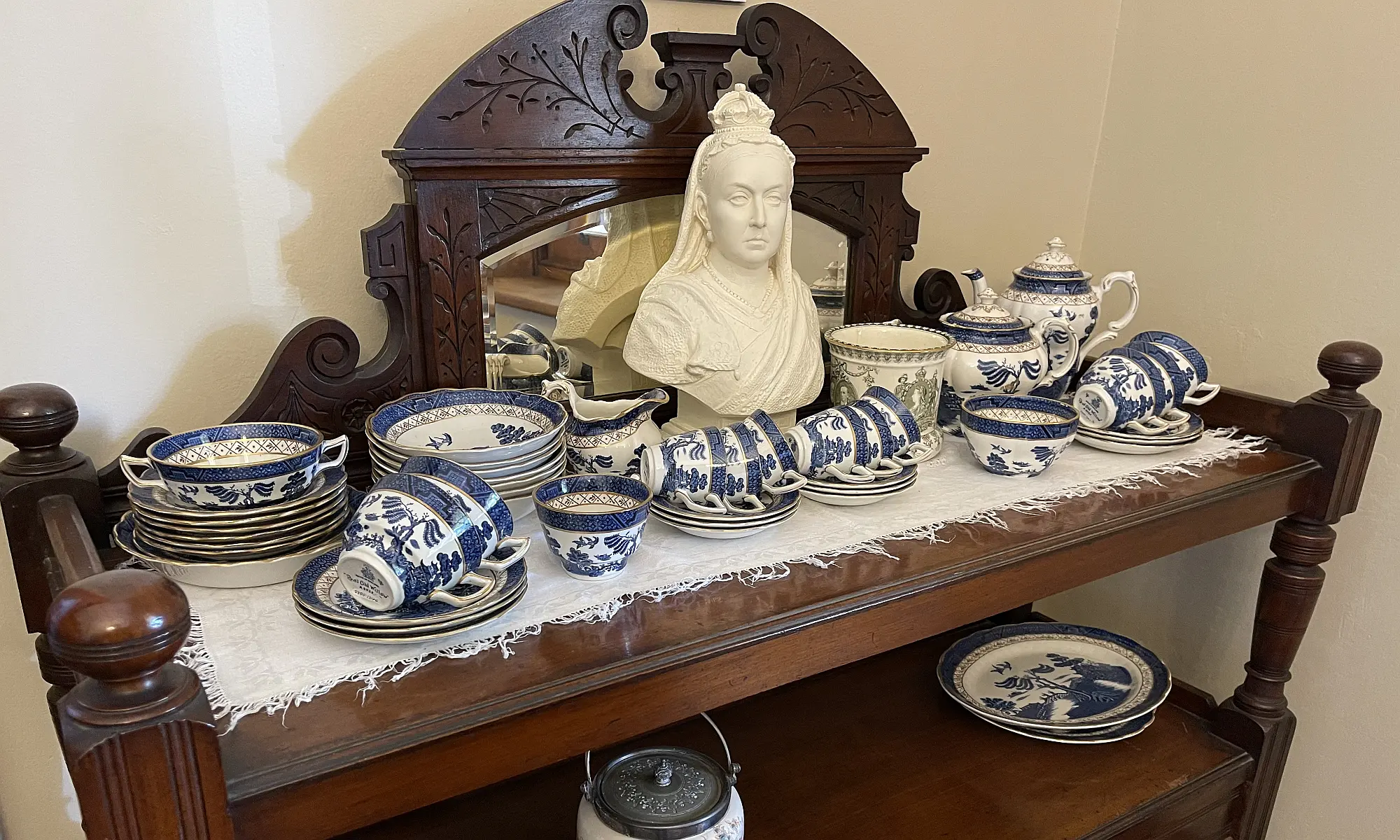
The Historical Society then arranged for the renovation and redecoration of the bedroom. This was followed by the re-arrangement of the sitting room and the redecoration and papering of the dining room. Then followed restoration of the room adjoining the dining room as a display room for the unique collection of Willow Pattern China which had been collected. This room was in an incredible state.
The dining room at Lydham Hall (Courtesy of Bayside Library Service Local History Collection)
As the building had no authentic kitchen, one was created by demolition of the laundry and the toilet and by building an artificial fireplace.
Finally the upstairs gallery was renovated and many of the artefacts previously stored were able to be displayed.
For nearly three years Miss Otton and I worked every Saturday, Sunday and Public Holiday and many evenings until after midnight to restore the interior while Arthur Ford maintained the grounds. Because of the complicated nature of the work, progress was often frustratingly slow but bit by bit it was accomplished.
The bedroom at Lydham Hall (Courtesy of Bayside Library Service Local History Collection)
By early 1978 the whole building was open to the public and the number of visitors per annum had increased from an average of barely 1000 in 1972 to almost 3000. Without exception, they were ecstatic in their praise. In 1978 Lydham Hall was twice featured on T.V.
In 1977, Alderman Phil Lang, a Council representative on the Local Committee, suggested that Council apply for a grant to erect proper accommodation for the Curator. Council’s application was successful and work began late in 1978. This enabled the show kitchen to be greatly enlarged and the unsympathetic fibro addition on the back verandah which had formerly housed the Curator’s kitchen to be removed.
During 1979 the former storeroom was attractively renovated as a display area for the very extensive collection of clothing the Local Committee had accumulated and during 1980 the gallery was recarpeted and provided with built in show cases. At the same time the slates on the roof were replaced, the verandah rebuilt and the rear garden landscaped.
The renovation and restoration of Lydham Hall to its present high standard of development has been quite a remarkable achievement in the relatively short period of ten years, particularly when it is realised that it was achieved by a handful of people who gave an enormous amount of their time, dug very deeply into their own pockets when funds were not available and endured endless frustrations.
The drawing room at Lydham Hall (Courtesy of Bayside Library Service Local History Collection)
Lydham Hall stands today as an outstanding tribute to the foresight of the Aldermen of Rockdale Council who in 1970, agreed to purchase it; to Miss Otton for the immaculate way in which she maintains it and to that very loyal but again, very small band, of Historical Society members who give up their time to conduct visitors through the building.
Since its opening in February 1971, more than 20,000 people have inspected the building and it has proved one of the Council’s most effective public relations outlets.
Lydham Hal, 2004 (Courtesy of Bayside Library Service Local History Collection)
To complete this report I should mention also the work done by Alderman Reg Whiteoak and Mr Arthur Ellis in the early days of the restoration and Mr Lloyd Deller of the Council’s staff in more recent times, but above all I should record the names of three Council Officers, Mr. (now Alderman) Charles Daly, Mr Kevin Casey and Mr John Franklin. Without their sympathetic assistance and their help in so many ways much of what has now been achieved would never have been possible.
At the same time, I should mention those hundreds of people too numerous to detail individually who have given or lent furnishings and artefacts of priceless value to make this home one of the most attractive restored Victorian residences in Sydney.
This article was first published in the June 1981 edition of our magazine.