by Vincent Saunders
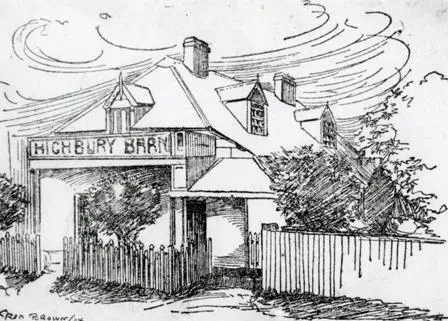
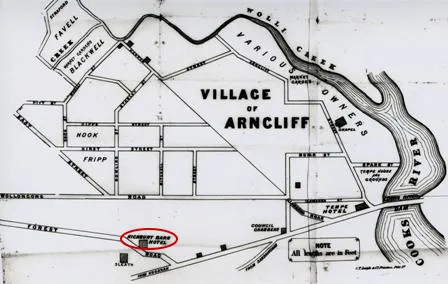
It could truly be said that the taverns of the St George District were intimately connected with the 1800s settlers. No less was this so than in the area later known as Arncliffe, the location of the first tavern in the district. It bore the name, Highbury Barn. This ale house was erected for Thomas Kelsey on the northern corner of present-day Kelsey Street and Wollongong Road, where the cellars of the original building are still extant beneath the cottage which now covers the site. Highbury Barn, of slab structure, is said to have been built by paid convict labour and came in the wake of the construction from 1843 – 1845 of Wollongong Road, the first main road through the district.
This famous road began on the southern side of Cooks River, adjacent to Tempe House, and followed the reverse side of the knoll on which Arncliffe came to be built. Thereafter, it climbed along the ridge (becoming present-day Forest Road) and wend its way to the crossing at Lugarno on Georges River. The country through which the road passed became a source of timber and charcoal for 1800s Sydney for many years, and in the wake of the road came pioneers – axemen, sawyers, and charcoal burners to this rural setting.
The intriguing question arises as to how the Highbury Barn came to be built at this particular location. The answer: water. At the time, a creek ran through the area, providing, until the first decades of the 20th century, a watering place for horse teams drawing wagons and drays along Wollongong Road. In addition to a watering place for horses, an astute publican saw the business possibilities in erecting a tavern near a workers’ camp to meet the voracious need for liquor from those engaged in denuding the forests and conveying timber and charcoal to Sydney Town. And so the first tavern in the district was built, c. 1845.
In 1861, the government of the day sought to improve upon the primitive condition of Wollongong Road along most of its old route. However, it was to begin near the present junction of Forest Road and Princes Highway, representing a detour, in the Arncliffe section, from the original Wollongong Road. The reason for this detour, which we know so well today, was due primarily to the drier conditions enjoyed by pioneers on the ridge extension of Forest Road in comparison to the lower reaches of Wollongong Road, which often became a quagmire after rain. These were the days before modern drainage systems. This ridge, it had been found, provided better traction for the wagon teams than the lower areas of the old road which often became impassable, holding the wagons in the tight grip of deep black mud.
The reconstructed road opened in 1864, causing Kesley’s old tavern to decline in popularity. It was found that the horse-drawn vehicles (mostly to and from Sydney) were travelling along the new ridge extension and thus by-passing the tavern on Wollongong Road.
Paradoxically, water, which had acted as the force which gave birth to Highbury Barn, was also the prime factor in its decline and the decision to relocate it to a nearby ridge with improved drainage.
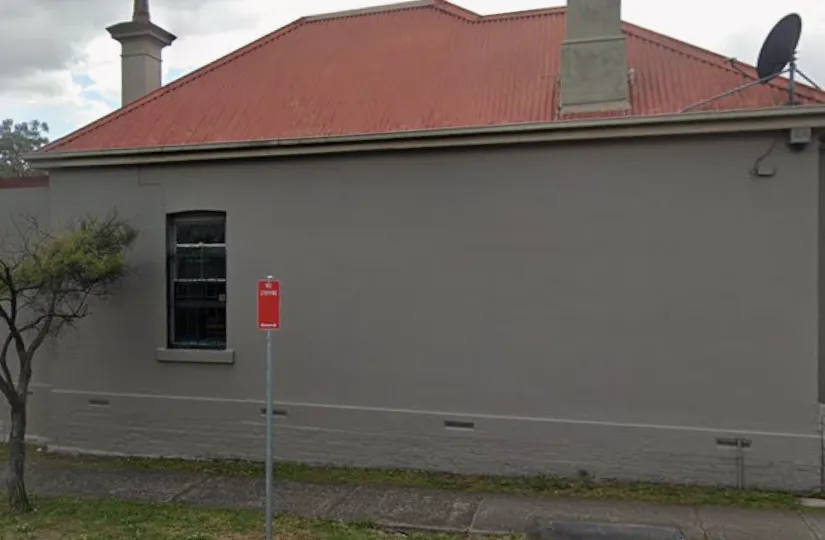
After observing the changed traffic pattern, Fred Barden acquired a home (probably the first on the Forest Road extension), which stood on the corner of the present Barden Street, and converted it to a new Highbury Barn, the liquor license having been transferred from the original site and owner in 1872. The new inn was of stone construction and local tradition has it that the stone was quarried from a nearby site at the corner of Roach and Gore Street, remnants of which are still visible.
Barden’s inn, standing in relative isolation at this time on Arncliffe Hill, had a monopoly of the passing trade for many miles around for over a decade, until a new hotel was built in 1880 and named the Botany View (the site of the present-day Airport Hotel).
Highbury Barn was modernised in the 1880s and continued as an hotel until a referendum brought about a reduction in licences in 1911. Soon after, the famous inn, which had been an institution in Arncliffe and the district, closed its doors for the last time.
In 1914, the building was converted to shops, persevering until it was demolished, along with the Arncliffe theatre, in the 1960s to make way for a service station. So the name Highbury Barn, which had been a household word in the district for almost 120 years, passed into history. The old Barden home, “Highbury”, was at the top of Highbury Avenue (renamed to Queen Street in 1963).
This article was first published in the August 1966 edition of our magazine.
Browse the magazine archive.
Unless noted, images courtesy of the Bayside Library Service Local History Collection.