by Bernard Sharah
I have been recording an oral history of my maternal grandfather, Barney Jarvis. These are some of his earlier recollections. Although he now lives at Miranda, he spent many years of his life in the St George district.
My grandfather was born Bernard (Barney) Richard Jarvis at Kogarah on 28th July 1899. He is the son of Alfred Walter Jarvis from Nottingham and Sarah Hart, a third generation Australian of Irish stock.
Sarah Hart’s great grandfather, Thomas O’Neil, was a convict transported at the time of 1789 Irish Rebellion. Recently it has been established that Thomas O’Neil was the first European to settle at Mosman (1811). Sarah was a devout Catholic who went to church every day. “As long as I can remember she’d go to Mass every morning – hail, rain or shine – never miss! Never complained. Oh, yes! She was not one that was outspoken. Her thoughts would be kept to herself. She had a family to look after and that’s what she did.”
Barney describes his father, Alfred Jarvis, as “an easy-going type”. He was a plumber and would work all over Sydney. In the days before the motor car came within the reach of the ordinary person a tradesman would have to travel by public transport. In his leather bag would be his tools of trade, vice, stocks and dies. Materials would have to be delivered to the site by arrangement with major suppliers such as Anthony Hordern’s.
The Jarvis family first settled in a house in Green Street, Kogarah until the 1890’s depression forced them to sell the property. They then rented a house at the corner of Regent and Premier streets, Kogarah. Years later Barney, together with his brother, Fred, and his mother bought the house. It is still there today tucked in behind some shops erected in the 1920s.
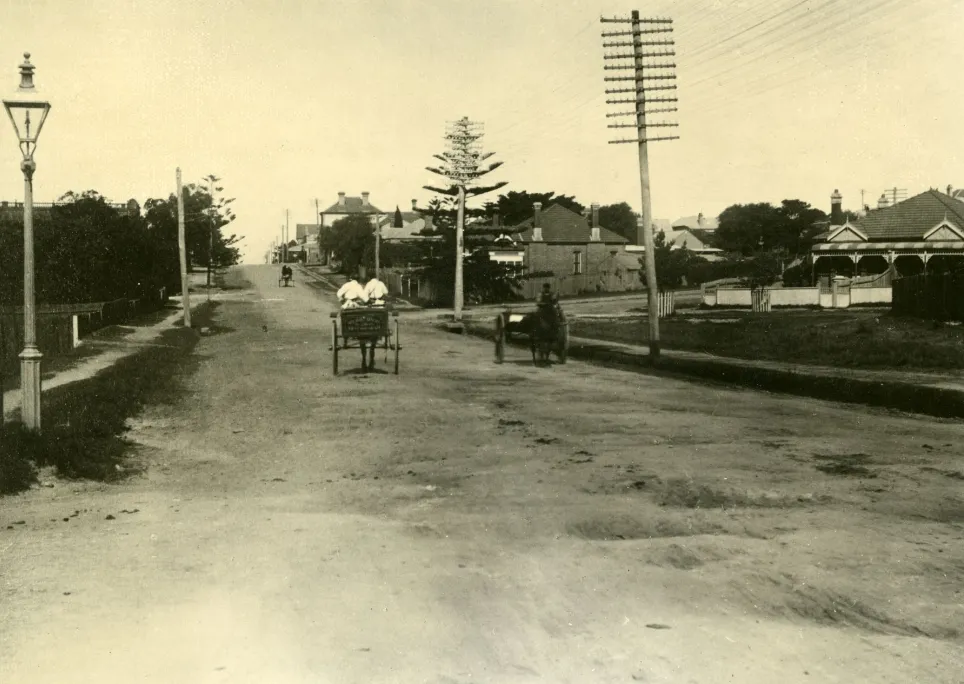
Sarah was 46 years old when Barney was born. He was the youngest of ten children. The eldest, Edwin (“Ted”), was 22 years older and had shown considerable scholarly ability. He repeatedly won an annual prize given by a Bexley solicitor to the best scholar between the Cooks and Georges Rivers. But when the family home was lost Ted took a job as a railway clerk because it offered regular employment.
Barney grew up in the Kogarah area and went to Marist Brothers High School. In fact, he was present the day school opened in 1909. The original school was the present main building of the college. In those days it was single storey and contained three classrooms which were divided by timber and glass partitioning. The teachers in those early days were Brothers Pius, Albert, Eusebius and Gonzaga (the Principal). Brother Pius was very popular and much admired by the students.
Norman Gilroy, later to become Cardinal Gilroy, attended Marist Brothers at the same time. He was a number of classes above Barney but my grandfather does remember him. He had a brother, Ted, who was in the same class as Barney. Also in his class were Ted and Tom English. The English family was one of the pioneer families of the Kogarah district and one of the most well-known. They operated a hotel on Kogarah Road (now Princes Highway) and various members of the family owned substantial residences in the vicinity. The English paddock later became present day Jubilee Oval.
Barney describes the area surrounding Marist Brothers school: “The area was called Nanny Goat Hill. When you came from the railway you went over a little bridge across two little creeks. When you got past the bridge you went into what was called Fry’s Paddock. It was partitioned off by a little gate which allowed you to go in. When you got to the top there were no buildings at all there then.”
What sports did you play?
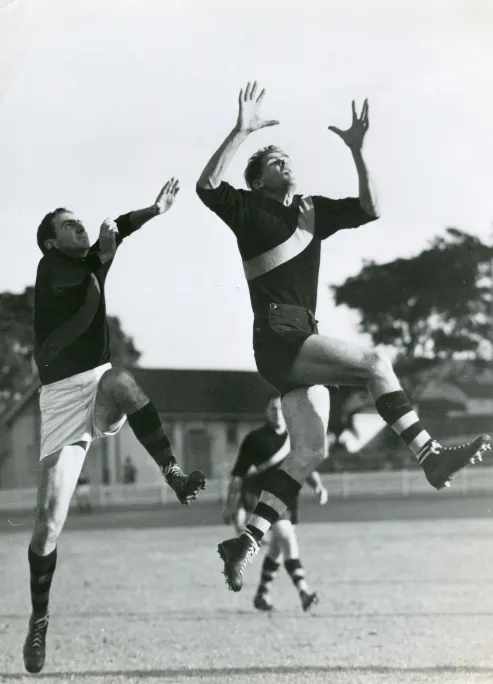
“Cricket, football, swimming. Well, I was never one for cricket. I liked playing football. When you went home you’d go down to the local paddock – there’d always be a game of football.”
At the age of 16 Barney was apprenticed as a boilermaker with the Railways Department working at the Eveleigh Workshops. He met and married my grandmother, Laurie McInnes, at the age of 25. They were the same age within a few days of each other but that’s where the similarity ended. Barney, determined, reliable, a man of rock-solid faith and Laurie agnostic, easy-going, good natured and generous. They complemented each other wonderfully. They were to have 5 children over the next decade and a half. For a short time they lived at the Regent Street house until it was sold after his mother’s death in 1926. For the next 40 years they were to move from house to house living in rented accommodation.
Harbour Bridge
Barney got a job with Dorman Long’s, the company engaged to construct the Sydney Harbour Bridge (construction started in 1908, the bridge opened on 19 March 1932).
What was it like working on the Bridge?
“Alright. It was work the same. Of course we were getting more money than the average worker. You see, the pay then for a tradesman in the same trade as myself was something in the vicinity of a bit over £5. We got £10.10 that’s ten pounds ten shillings a week and when you went from the 7th panel to the 14th panel you got another pound. So that was really double the money. But you only got paid for what work you did. You started at 7.30 in the morning and finished at 4. There was no holiday pay and there was no annual leave.”
Barney remembers a great deal about the construction itself. Talking about the prefabricated sections of the bridge he says:
“Some of those sections would be about 130 tons. They were not just things that would be lifted by an ordinary crane. You had a crane that was on a platform that contained a creeper crane that lifted all the big sections. That was in the front and you had 2 derrick cranes at the back. Then in front of that creeper crane and down a bit lower was a travelling crane. It went from one side to the other bringing up scaffolding and light things. That creeper crane put certain sections in position. (They were then bolted and and riveted.) The creeper crane would (then) move out to another section. A creeper crane would be 400 tons that’s with the platform and the two derrick cranes at the back. If you just imagine the strain that that is putting on the 72 wires that held that in position. Imagine the leverage it had on those wires.
“When the arch was finished they put down what we called droppers. That was the post for each part to hold the roadway. Those posts connected up underneath the arch and held the roadway. When they got to a certain stage they put off various ones (workers). Well I got put off and I came back to live there at Regent Street. There was no work. All the shops were closed down.”
The Great Depression
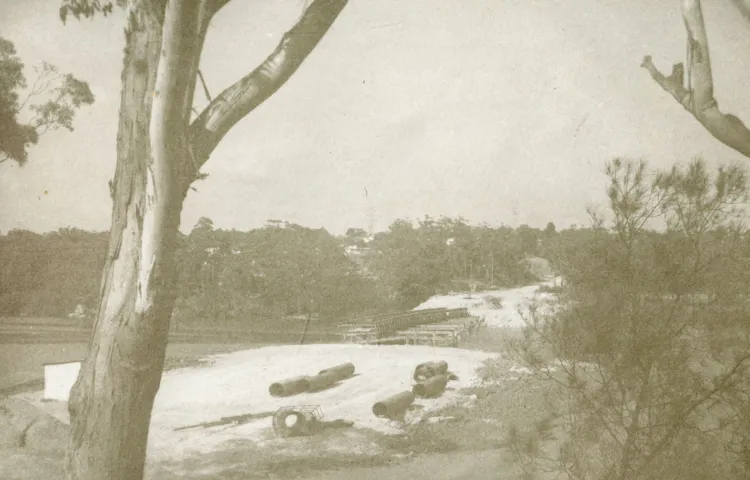
“I was on the bridge for between 3 and 4 years then when I got put off I went to live out at Lugarno. I thought to myself it’s no use staying about the suburbs – there’s no work! And I thought I can get out there and grow something to keep the pot boiling. Which I did. There was no work anywhere! Shops that I knew would be employing in usual times a 100 tradesmen – nothing! Mort’s Dock and Cockatoo were closed down. So I thought it’s far better to see it out there (Lugarno) than what it would be in the suburbs fooling around.”
And what did you do at Lugarno?
“Well, I got a vegetable garden growing there and I used to sell things on the weekend. Get a bit of money that way. Of course it’d only be pence!
“Fred (Barney’s brother) came to me and asked me if I’d go in with him. He said he’d give me a share in his poultry farm. I used to walk from Lugarno all the way along Forest Road until Belmore Road then go down to the station down there and go along the railway line over Salt Pan Creek and make my way up Gibson Avenue towards Canterbury Road. The poultry farm was before you got to Canterbury Road. And I’d walk home at night-time. I did that for years.
“I reckon it must have taken me an hour and a half in the morning and more at night. You think over it, it’s not a couple of miles, it’s more than that and I never got a penny out of it. Sharing the business was nothing! The eggs went to the merchants in Sussex Street. They would deduct the cracked eggs, soft shells and you’d finish up getting between six pence and nine pence a dozen and paying for the cartage.
“During the Depression (global economic downturn 1929 – 1939) you could go along any street you like and a third of the people in that street were out of work. Then you had a certain section that would be working three and four (days) and women weren’t going to work then. There were very few women at work.”
There were soup kitchens and dole queues?
“People got dole. I got dole there at Hurstville. I used to walk in from Lugarno and I’d go to Hurstville Oval and we’d sit up in the grandstand and the policeman would be down on the ground and he’d call your name out. You’d go down and get your bread tickets and you’d go inside and get your other tickets for the butcher and the grocer. That’s how it was then. You’d go to grocer’s and you’d get what the grocer would give you. There wouldn’t be much pickin’ and choosin’ in the early stages. You got tickets to get your groceries but they’d have a lot of things made up for you. Things possibly they’d want to get rid of.”
Working Conditions
Towards the end of the 1930s things improved slightly but it was the war (World War II, 1939 – 1945) that brought about full employment and ironically, improvements in working conditions.
Barney worked for a number of companies including Dorman Long’s again, Sydney Steel and Waugh and Josephson. “They (Waugh and Josephson) built a lot of the tractors, you know, for making the flying fields for the air force. Well, I worked there during the war years and before that I was down at Garden Island. They were getting a light cruiser ready. And when they got it out that was the start of the war. And before that I went down to Tooth and Co’s Brewery. I went there for the reason they were giving a week’s holiday a year. Because you couldn’t get any holidays from anywhere. You never got paid for public holidays or you never got annual leave.”
So when did paid holidays come in?
“Well that came in during the war years and Chifley (Ben Chifley, Australia’s Prime Minister 1945 – 1949) was the one that handed that over. We got a week. Well, they built on that week to two, and a bit more and a bit more and it’s up to four weeks now.”
So you worked a whole year and you didn’t get any holidays?
“No fear! You never got public holidays either – you got them but you didn’t get paid for them.”
Did you get the time off?
“You got the time off – it was just like Christmas time. When Christmas time came they would tell you that they were closing down but if you’d like to come back after Christmas you’d get a start. That was very… generous, wasn’t it? So it came Christmas time and you had to turn around and find something to buy… toys and things like that, presents. Oh it was a pretty hard job to do.”
The Depression years were very hard times but somehow my grandfather always brought home the bread if not the bacon. Like he says of his mother – he had a family to look after and that’s what he did. In 1958 he built a house for Laurie and himself at Miranda – the house he lives in today.
At the age of almost 93 Barney is still fiercely independent. Although confined to a wheelchair and being handicapped by poor eyesight and hearing he manages to fend for himself. He cooks some of his own meals, rakes the leaves in the backyard and has even been found replacing tiles on the bathroom floor. No longer able to read books he enjoys watching television, particularly Rugby League. He has had a life-long interest in the game. In his youth he played for a junior side called the Arncliffe Waratahs. The enthusiasm for Rugby League is a family one. A grandson, Pat Jarvis, played first grade for St George for many years and was selected to play for Australia a number of times.
Unless otherwise noted, images are courtesy of the Georges River Libraries Local Studies Collection.
This article was first published in the July 1992 edition of our magazine.
Browse the magazine archive.