by Laurice Bondfield
Members or website visitors can comment on our blog posts, reminiscing or passing on information.
We recently posted an article to our blog from the March 1970 edition of our newsletter. In “The Latter-Day Personnel of the Sans Souci Tramway“, Gifford Eardley stated:
“The Sans Souci Tramway functioned smoothly and well under the administration of that redoubtable man the late William Pendleton Officer in Charge…….. (he) was most efficient in carrying out his multifarious duties in a way which did not give offence to either the travelling public or the men placed under his directive.”
Soon afterward, William Pendleton’s grandson Ken Pendleton added personal details about his grandfather whom he remembers meeting at William’s house near Jubilee Oval. Not only did his grandfather start his career at the Newcastle Tramway but he drove a tram to Sydney when the Newcastle line closed.
The Sans Souci Tramway, its personnel like William Pendleton, the drivers, conductors and mechanics, were well respected locally and when the line closed on 4 July 1937, the VIPs on the trolley buses which replaced the trams were booed. The trams themselves were covered in wreaths with signs on them like “Good Old Faithful” and “Gun’s Gully Express” as locals mourned the closing of a popular local service, which at its height in 1935 , carried 2 million passengers. This last tram left Kogarah station at 12.38am and more than a thousand people joined it for its last journey. Some were souvenir hunters who brought tools to grab signs, seats and even railings!
Such a sad ending to 50 years of service to the local community.
Its opening on 10 September 1887 had attracted no fanfare but the speculators who had bought tracts of land at Sans Souci to auction offered free rail and tram tickets for prospective buyers. Tickets were usually threepence per section and fourpence for those paying in cash.
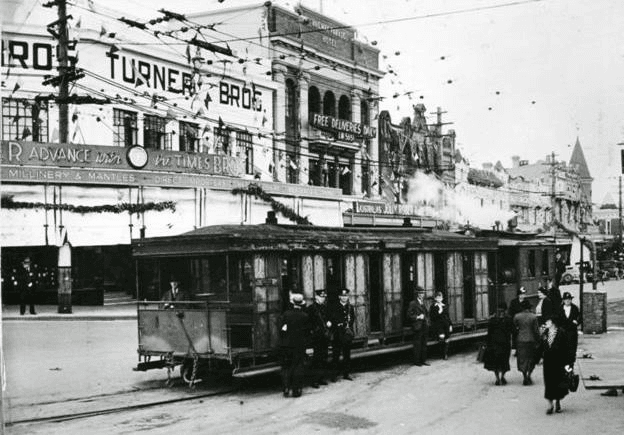
The trams began at Kogarah Station, where there was a loop area for the trams to turn and be loaded with coal and water for their next journey. Much to the delight of small children watching, just before the tram began a trip, a mechanic with an oil-can greased the wheels and some other moving parts. All ready, it took on passengers and steamed off along Railway Parade, turned down Gray Street and up Carroll’s Hill where passengers could enjoy a fine view of Botany Bay and to the southwest Kogarah Bay with the small Aboriginal settlement on its shores. It steamed on to Ramsgate Road “in the centre of a vast forest interspersed with swamplands”, continued along Rocky Point Road to Park Road, turned southwest through “tree covered country” to the Loop Junction near the intersection of Russell Avenue. Chugging along through the surrounding forests which “did not survive the coming of the tramway for very long” it continued to St. Kilda Point and the Georges River where it turned into the “grass thoroughfare known as Fraters Avenue near the famous Rocky Point Hotel and its equally famous pleasure grounds” into Riverside Drive, passing over the remains of shellfish middens – evidence of the many thousands of years that Aboriginal people had lived in the area. Perhaps stopping at the shed at the bottom of Napoleon Street, a tram would trundle along an embankment through a shallow lagoon known as the “Serpentine” to reach the notorious Prince of Wales Hotel at Sandringham. This establishment was known in the area as “blood and guts” because of the frequent brawls that occurred there. The tram then continued along Clareville Avenue through dense forest country to Russell Avenue then rejoined Rocky Point Road to return to Kogarah.
Over the fifty years of its operation the route changed and was expanded before being ousted in favour of electric trolley buses. Nevertheless as Gifford wrote, “Is there any other man-made machine which can inherit such sentimental attachments as those appertaining to the steam locomotive?”
The trams no longer exist except in museums like the Sydney Tramway Museum at Loftus but they still attract passengers there. The descendants of the workers who staffed and maintained the trams, like the Pendletons, remember them with pride for their skill and devotion to the smooth running of this essential service to the people of the district.
As a ditty going around the workshops of the service in its last days explained:
“My work out here is done
And when I leave the Kogarah scene
That’s the last you’ll see of steam
No more I’ll grunt and puff
I’ll leave you to the trolley bus”
Note all quotations are from :
The Trams of St George by Gifford Eardley and Barry Johnson.
“The Latter-Day Personnel of the Sans Souci Tramway“, Gifford Eardley, March 1970 edition of the St George Historical Society Newsletter.