
by Gifford and Eileen Eardley
This ecological survey relates to the charms of the pretty natural forest scene at Girrahween Park, an unspoilt wilderness of Hawkesbury sandstone country located at a short distance to the south of the busy shopping centre of Earlwood. The nature strip in question descends from the crest of Campbell’s Hill to reach the waters of the willow-fringed Wolli Creek. It is true that at times this sluggish stream becomes stagnant and smells to high heaven, an unfortunate circumstance brought about by household detergents which destroy every living creature which normally would assist in keeping the waters pure and clear. This sad state of affairs is one of the side-benefits (?) of suburban colonisation, as much of the upper watershed of the stream permeates through unsewered areas, and unsavoury run-offs quickly find their nauseous way through open brick-lined channels to the main course of the once so beautiful creek.
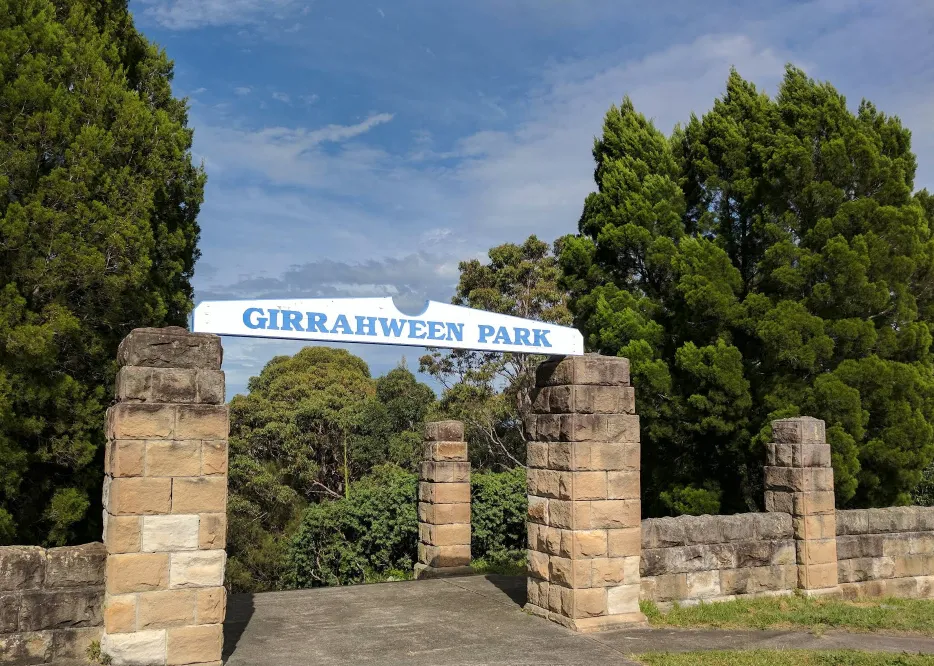
Girrahween Park is entered from an obscure gateway partly hidden from view at the western end of the enclosure, the entrance being sited at the northern low-level end of the aptly named Fauna Street, which is very close to Bardwell Park Railway Station. The following story of the wild growth and natural, inhabitants of the park is based on personal observations made, at various times, throughout the years in the course of many walking excursions through the area. There is no other way of seeing its wonders. It is a fascinating place for the nature-lover, although like the Biblical Eden, one has to tread warily as there is an infestation of snakes of diverse sorts and sizes. One may, on occasion, see Tiger snakes, Brown snakes, Black snakes with red bellies, and Green Tree snakes, most of whom readily get out of your way, a feeling that is mutual. Their presence is not much good for the nerves, but certainly proves what an untamed and therefore beautiful wilderness exists within ten kilometres of the City of Sydney.
It is surprising to see the diverse forms of flora and birdlife which persist in this rocky district, the terrain possessing such a steep slope that, fortunately, it has escaped the greedy attentions of early land speculators, being regarded as utterly worthless, thus it was dedicated as a public park. We trust that it will remain so for all time.
Immediately north of the entrance gate, in times of yore, was a steep sided rocky cul-de-sac, which dropped down at an angle of about 1 in 2 from the upper level as marked by the former Earlwood tram terminus in Homer Street. These slopes, on all three sides, were covered with a mass of privet, intermixed with broad-leafed castor oil trees, from the branches of which turtle-doves cooed, whilst many bul-buls and silver-eyes haunted the low thickets of ink weed, the plump red berries of which were greatly to their liking. From the cul-de-sac a narrow pellucid creek flowed, passing through banks of Kingcups and Buttercups, and also beneath the tangled living branches of a fallen willow tree of Chinese ancestry. It was a peaceful spot, until the rubbish-dumpers came and sullied the slopes, to be followed by the mullock-dumpers who gradually raised the erstwhile valley bottom to street level to form a carpark for the local shopping citizens. It is now an unlovely area with a raw clay surface, sticky in wet weather, no doubt patiently awaiting the benefits of a tar sealing compound.
The pellucid creek, now only a stormwater trickle, still flows beneath a narrow low wooden plank bridge with a single shaky handrail. In the waters could, at one time, be discerned several tiny fish, about an inch in length, together with gambolling bully-frogs (tadpoles to be correct) who wriggled their way along by swishing their long tails to and fro. A stream of any size is always an interesting feature to those people blessed with a discerning eye. An understanding, no matter how slight, of natural history, tends to preserve one’s equanimity and gives a sense of great pleasure. One pries into other worlds besides his own.
From the creek bed the footpath in the park leads eastwards, following the alignment of the boundary paling fence of the neighbouring Roman Catholic School ground, the lower portion of the fence being of ashlar stone which, by the ever present dampness, forms a good harbourage for ferns and spongy moss. Veering to the southeast the path enters an area of hardy and somewhat prickly native shrubs, some of which are fragrantly aromatic. Here are to be found scattered bushes known to the local populace as “Eggs and Bacon”, but a plant which botanists choose to call “Dillwynia eriofolia”, a brilliant yellow orange pea-flower, hence its common name. There are tall bushes of the “Honey flower”, or “Mountain Devils”, which prefer to be known as “Lambertia formosa”. White Heath and showy sprays of Native Fuschia are also to be seen in this floral stretch. It is most unfortunate that bushfires are started more or less regularly on hot summer days about 3.40 pm presumably by schoolboys exhibiting their prowess with a box of matches; at times three separate fires have been lit within five minutes of each other, the flames sweeping through this particular area, greatly to its detriment.
The path now reaches a pleasant grassy sward, replete with swings and other mechanical amusements for the young, and the long-haired youths to play with. A shelter, strongly constructed in concrete after the manner of a huge rock cave, is also included amongst the amenities. One or two Turpentine trees, with their deep green foliage, tipped here and there by bright red pendant leaves, give an indication that the soil hereabouts is of a rich nature.
Westward from the pleasure ground is a wide expanse covered to a certain extent with a rampant growth of sword-like leaves belonging to a species of brick red Watsonias. This is a no-man’s land and somewhat snaky withal. Its lack of interest debars entrance to its precincts.
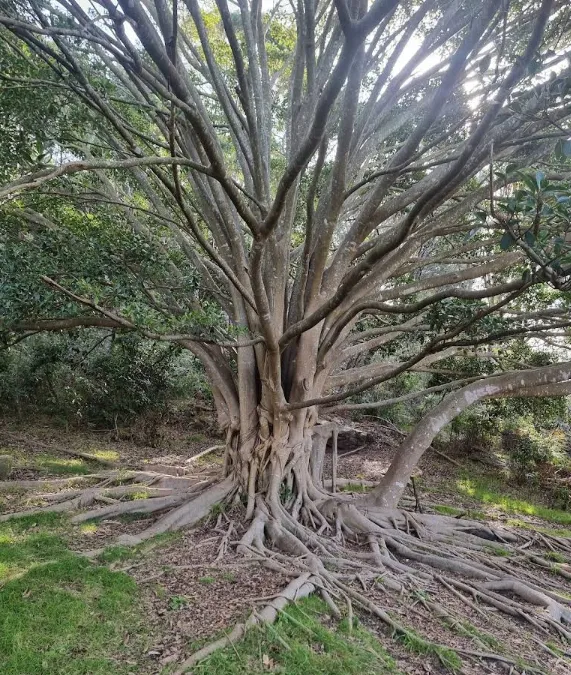
From the pleasure ground the path again turns eastward to enter a grove of large trees of diverse sorts. Few areas in the St George District are now graced with such a prolific growth of Sydney Redgums. It is true that they are only half-grown spindly specimens, but these trees exhibit all the endearing traits of trunk sculpture in the way of grotesque bends, worts, bumps, changes of mind, and other indescribable features associated with this particular species of the Angophora, or Smooth-barked Applegum. A winding path wends its way northward through their midst, its sun-dappled surface covered with the small goblet-shaped seed capsules dropped from the scented leafage above. Beneath the trees is a sheltered tangle of native growth which includes an occasional Wild Parsley plant, and clumps of Old Man’s Beard. The deafening whir of cicadas is to be heard in December when the piercing notes of the “Black Prince” variety appear to dominate, although the “Floury Baker” utters more than its fair share of vibrant noise. “Yellow Munday’s” and “Green Grocer’s” are also evident, but only a connoisseur could judge them on their vocal merits. It is all good bush music and truly Australian in its intensity.
The main path soon reaches a wide shallow gully, which is circumnavigated around its northern end, the route keeping clear of a high wind-eroded sandstone outcrop which contains a small cave within its structure. This is backed by a couple of large Lilli-pilli trees of the Eugenia Smithii variety, and are noted for the quantities of pink globular-shaped acid-tasting fruit, which hang in clusters and ripen in early winter. Stepping stones cross a streamlet of the “bosky-dell” style, whereby the rock enclosed water trickles downward in a series of short falls, leaping from rock to rock amidst a wealth of ferns and pink-flowered Dog-rose (Bauera rubiodes). Against the path a small pool is banked up by a drift of sand and small pebbles, in which a few tadpoles lead an idyllic life, that is unless they are spied by a foraging pee-wit.
The woodman, in days long past, denuded the hillside of its larger trees, which would comprise the sturdy angophoras on the upper slopes, and tall Blue-gums (E. soligna) standing in the grass hollows and along the banks of the neighbouring Wolli Creek. An occasional Banksia-tree is to be seen, likewise numbers of small pines of the She-oak variety with needle-like foliage and spindly trunks.
Clear of the shallow valley the footpath continues eastward, rising and falling with the lay of the land, dodging old stumps and out-jutting slabs of rock as the obstacle warranted. Here, unfortunately, the pink flowered lantana has taken over to a large extent, to the detriment of the indigenous growth, but later we enter a ti-tree region, so dense that the imported pest is unable to get a footing. Down in the creek can often be seen a “paddling” of Black Duck, generally in single file, prospecting the innermost secrets of the reed-beds, a sport shared by clucking Bald Coots and Purple Breasted Gallinules, the latter displaying their gaudy feathers, both species flicking their brilliant white tail feathers to denote their whereabouts to other members of their tribe. The reed-beds form a haven for reed-warblers and tiny grass birds, the former having a most melodious song, and the latter a two-toned note, a call uttered at long intervals, which serve to accentuate the otherwise silent surroundings at midday, when the other feathered inhabitants are enjoying a siesta. Dotterels roam the muddy margins of the stream, and at times a large white crane with a black neck stalked into view seeking some hapless frog for his midday meal. This used to be “Cuckoo Country”, but these seasonal visitors have been absent for the last fifteen years or so. Evidently the destruction of the natural vegetation in the Arncliffe and adjacent Earlwood area generally has destroyed their habitat, together with that of the small birds chosen by them as foster parents for the hatching of their solitary egg and the upbringing of the chick. Destructive man has played his part by unthinkingly upsetting the balance of nature.
Emerging from the ti-tree thicket to cross over the concrete sewer viaduct bridging Wolli Creek, we reach a low grassy hillock where, once upon a time, stood a tiny cottage, possibly built of upright wooden slabs, with a wide-shouldered stone chimney at one end. A few years ago the foundation stones of this primitive cottage could be traced in-situ and its general construction, no doubt, would have afforded considerable interest to an architectural historian. The builders of the cottage have not been traced and the site today is marked by a nearby clump of orange-flowered Buddleia, a plant which was the vogue in the 1870s, and is today somewhat of a rarity. It is rumoured locally that this homestead was originally associated with a pig-farm.
Away from the haunt of man the adjacent Wolli Creek, flowing through its valley known locally as “The Second Gully”, is flanked by a flourishing spinney of beauteous Silver-poplar trees which the authors planted many years ago. These trees, with their silver-backed leaves, look lovely as they tremble in the breeze and produce beautiful autumn tones of yellow when the first frosts are setting. About 90 metres or so east of the poplars the reed-fringed stream unites with Stoney Creek, now known as Bardwell Creek, and at this junction the main stream turns at right-angles to follow a short northerly course. The adjacent rectangular shaped cultivation paddock, on the western side of the stream, has the old-time bridle track ranged along its western edge, hard against the base of the eastern flanks of Campbell’s Hill. The paddock has long lain fallow, and in part supports a growth of blackberries, and a covering of prickly-podded burr-like plants, also rank swamp grasses, all of which make a good feeding ground for an occasional flock of Ibis, and the ever present Blue heron. The bank of Wolli Creek has, in days long past, been raised above the normal water level and both on this artificial ridge, and on tiny islets in the water, stand a multitude of Weeping willows. It is a tranquil scene, especially in the Spring and Summer months, and one that is only agitated by the swimming movements of numerous Bald Coots, Black Duck, or by the cautious stalking of the various types of wading birds, including the showy White Egrets.
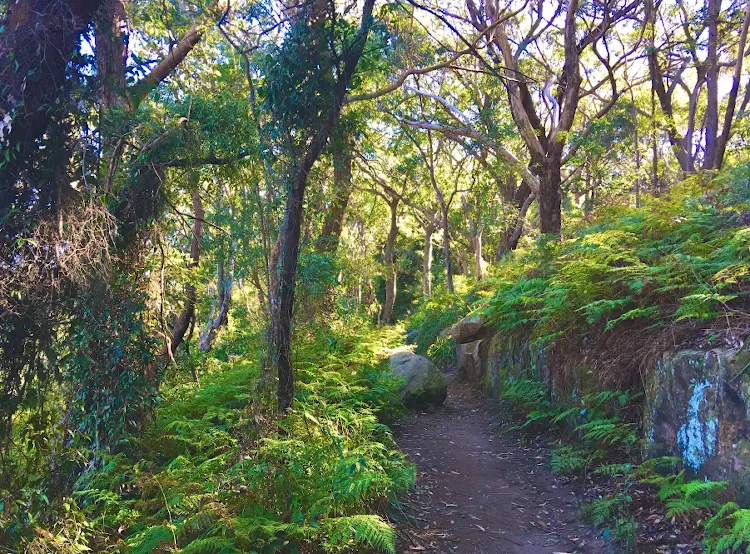
Returning to the site of the long defunct cottage we meet the precipitous cliff escarpment of the eastern side of Campbell’s Hill. A very narrow footpath leads from the cottage site northwards in a devious manner, dodging this rock and avoiding that as it entered a dense growth of ti-tree, myrtles, coachwood, and other moisture-loving vegetation, together with a floor covering of bracken, Twining Guinea Flower, and Maidenhair Fern. The foliage overhead is so compact that the sky is obscured, and one has to walk in humpty-backed fashion in order to dodge the entanglement of branches, a real drunken forest. No birds sing there as it is always dark and shadowy, consequently it is the daylight abode of small owls and, to a lesser extent, Yellow Breasted Robins.
The tortuous path affords a wondrous view of the huge rocks forming the escarpment, divided here and there by vertical cleavages, each about one metre in width, which give root footing for a wealth of the more robust ferns, and a toe-hold for mountaineering schoolboys. One rock in particular has been carved by the winds and the rains into a shape similar to a human head, complete with projecting brows and eye-sockets, a nose, and a horizontal cleft in the correct position for a mouth, consequently this stone wall has gained the name of “Skull Rock” from its youthful admirers. Next in line to “Skull Rock” is a massive overhanging cliff which has a deep fissure at its base, extending inwards about 1.2 metres, the opening being 30 centimetres in height and tapering back to the parent bedstone. This tiny cave, always moist and dripping with water, is fascinating in its verdant mossy beauty. The roof is covered with green spongy lichen, from which sprout minute ferns, whilst the floor has miniature sundews and other tiny botanical gems which give joy to the naturalist. It has a greenish eerie atmosphere, a place which imaginative people would associate with gnomes, elves, pixies, and other interesting folk.
Then comes the largest rock face of all, a real mammoth of stone which rises some 15 metres or more, its weathered face being covered in places by patches of lichen, and numerous little clefts hold small sprays of a miniature species of rock-lily which send forth, in due season, an equally small spray of pearl shaped coloured flowers. There is a perpetual trickle of water, from some hidden spring, which has been put to good use in days of yore as a source of supply to a deep concrete-lined swimming pool. This basin is now derelict as cracks have appeared in its outer wall of masonry, leaving only a depth of a couple of half a metre of water covered with Duck Weed, the only swimmers being green and gold-backed frogs. Dense scrub has grown around this now lonely pool making access most difficult. From the pool the path commences to wind its way down a steep slope, overhung with ti-tree, to gain the old time bridle path.
The path skirts the edge of the thick scrub until the bank of a deep pool, set amidst another grove of Silver-poplars, is reached, the abode of golden carp and large tortoises. Here the path scrambles up a steep slope to gain a higher level and, passing through a “bushman’s” gate of barbed wire, wends its way eastward and then northwards around the base of Nanny Goat Hill to join the main thoroughfare now marked by the long defunct course of Arncliffe Road at Turrella.
The channel of the Wolli Creek, at the above-mentioned deep pool, is thwarted by the southern flank of Nanny Goat Hill and the stream is diverted eastwards for a short distance before the northern course is resumed. Open grazing land forms the southern bank, this flat expanse once forming the drying paddock of the wool-washing establishment. Willow trees flourish in the marshy margin of the northern bank where an earthen wall, now topped with a dense mass of lantana, gave protection against normal floods to the long abandoned Chinese garden which sheltered on the flat plain towards Arncliffe Road. Up till about ten years ago, a lofty solitary Pinus Insignus dominated the landscape in the region of the creek. This imposing landmark was thought by the indigenous cormorant population to be ideal as a permanent roosting place, but finally their excrement killed the tree, and it was eventually cut down for firewood.
No roads go by the Girrahween Park area, although it is accessible, at many points, for those who like bushwalking. We trust that this sole remaining remnant of bushland, which once covered the whole of the St George District, will be preserved for posterity. The recent request for permission to quarry, for stone ballast, the whole of Nanny Goat Hill, shows what can happen if speculators and developers gain control of any portion of this splendid natural reserve.
This article was first published in the May 1972 edition of our magazine.
Browse the magazine archive.